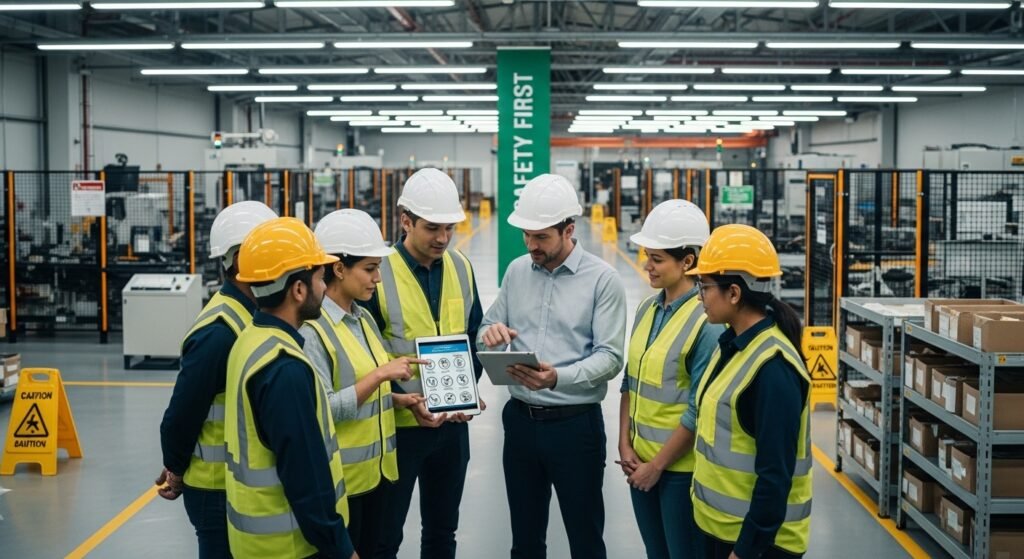

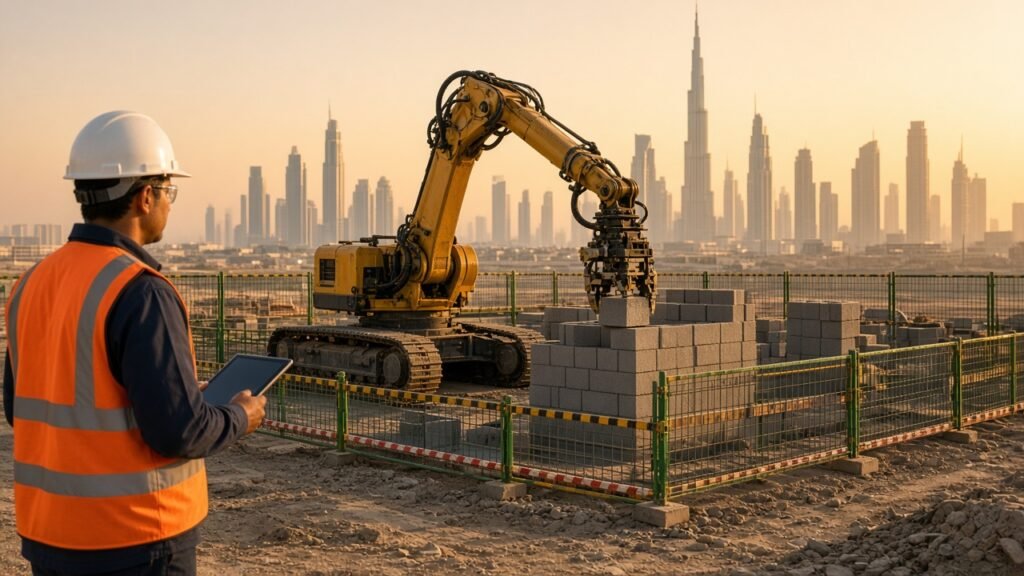
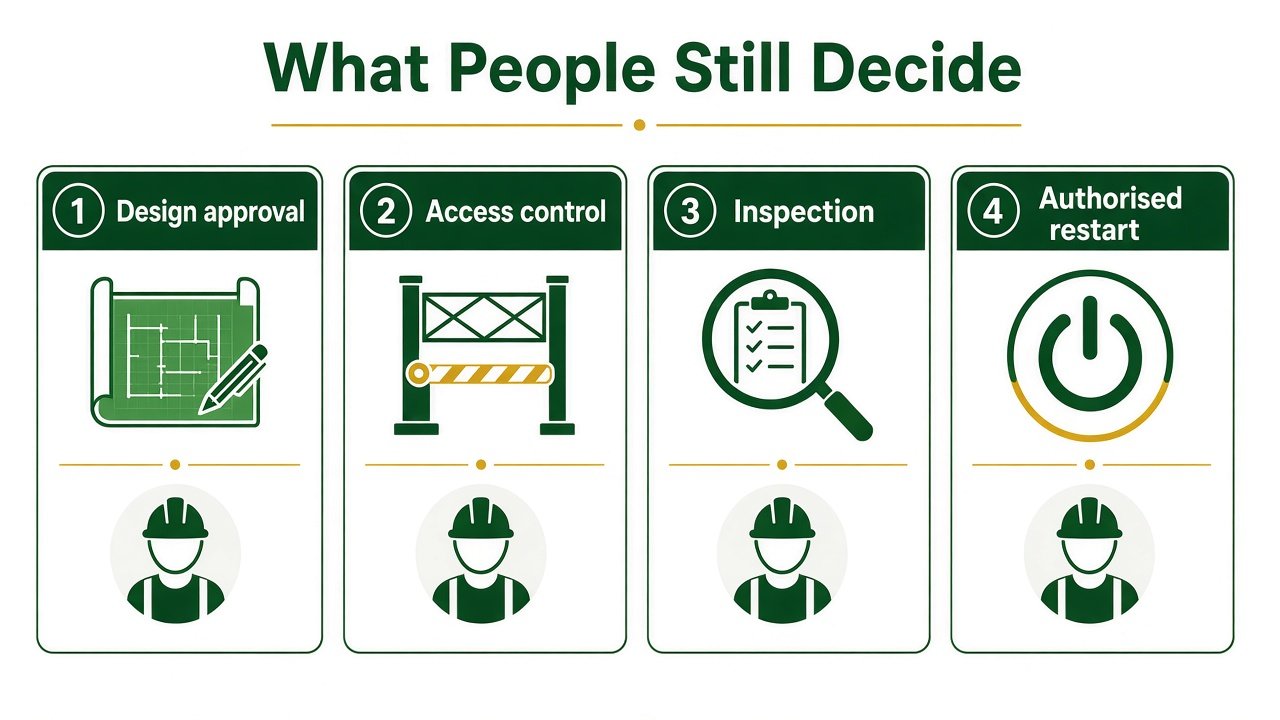
Construction robots still need people to approve the work, control access, coordinate other trades and decide when it is safe to restart. If you manage a UAE project, automation changes how you supervise; it does not remove supervision. A machine can follow a path without knowing whether that path still suits your site.
Dubai’s planned robotic-villa challenge makes that distinction timely. The useful question is not simply whether a robot can build a wall. It is who checks the wall, who protects the electrician working nearby and who takes charge when the machine stops halfway through a task.
Table of Contents
- What is Dubai’s robotic-villa project actually testing?
- What still needs human supervision on a robotic construction site?
- Can a cobot safely work beside your crew?
- How do you coordinate robots with other trades?
- Which Dubai and Abu Dhabi rules should you check?
- When should you stop the robot and reassess?
- What should your pre-start checklist include?
- Who is responsible if a construction robot makes a mistake?
- Frequently asked questions about construction robots in the UAE
What is Dubai’s robotic-villa project actually testing?
Dubai’s robotic-villa project is a challenge to demonstrate residential construction using coordinated robotic systems, not proof that UAE sites already run without workers. Dubai Municipality announced the initiative in January 2026 with Zacua Ventures and Würth Group. Human decisions about design, safety, inspection and acceptance remain central to the questions it raises.
The Municipality’s announcement describes a consortium of more than 25 technology companies and academic institutions. It calls the ambition the world’s first residential villa built entirely using robotic construction systems. Treat that as the project’s stated ambition, not an independently verified completed record.
Zacua Ventures’ participation call identifies possible contributions including concrete printing, material logistics, vision systems and multi-robot coordination. Würth identifies the Robotic Villa initiative at Expo City Dubai as a living laboratory.
Robotic construction and 3D printing overlap, but they are not interchangeable. Printing deposits material; robotics can also move it, position tools or collect inspection data. The sources reviewed do not establish a completed, occupied villa or widespread adoption across UAE construction sites.
What still needs human supervision on a robotic construction site?
You still need competent people to confirm the approved design, inspect materials and completed work, protect workers and manage changes. Robots can execute or measure defined tasks, but someone must decide whether the inputs are correct and the results are acceptable. Assign those decisions before the first automated cycle.
| Activity | What automation can support | Human decision to retain |
|---|---|---|
| Setting out and drilling | Repeat positions from a digital model | Verify drawing revision, services and permitted drilling locations |
| Concrete printing | Place material along a programmed path | Check material approval, testing, interfaces and acceptance criteria |
| Progress inspection | Capture images, scans and measurements | Investigate anomalies and approve or reject the work |
| Material movement | Follow a defined delivery route | Control pedestrians, ground conditions and changing access |
| Fault recovery | Report an alarm or stop | Identify the cause, arrange safe intervention and authorise restart |
Build inspection hold points into your method statement. For example, check an initial printed section before repeating it across the building. A consistent machine can reproduce the same mistake very consistently. Keep the drawing revision, inspection result and approving person together in the project record.
Can a cobot safely work beside your crew?
A collaborative robot can work near people only when the complete application has been assessed and its protective measures validated. The label “cobot” is not permission to remove barriers. Its tool, payload, speed, stopping behaviour and surroundings determine the risks, including trapping a worker against a wall or an edge.
ISO 10218-2:2025 addresses industrial robot applications and integration; Part 1 addresses the robot itself. ISO/TS 15066:2016 supplements industrial collaborative-robot safety requirements. Your integrator should identify which standards apply, explain exclusions and assess the complete installation.
Do not accept a generic certificate as a site risk assessment. ISO 10218-2 does not cover every construction hazard, including certain mobile-platform risks and severe conditions outside manufacturer specifications. ISO 13482:2014 concerns personal-care robots, not a blanket approval for industrial construction machinery.
NIOSH’s construction-robotics guidance explains why changing jobsites make human–robot interaction harder than in controlled manufacturing environments. Establish exclusion zones and engineered safeguards through the assessment. A supervisor watching the machine is not a substitute for suitable protective systems.
How do you coordinate robots with other trades?
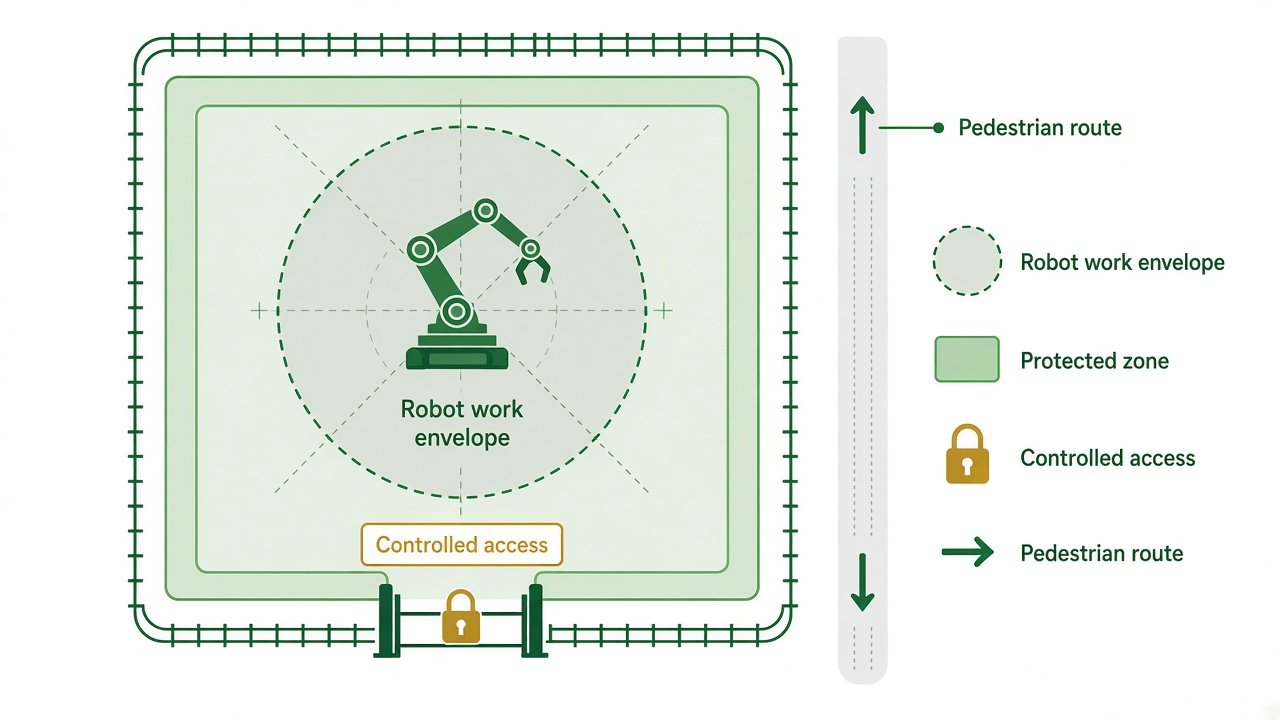
Coordinate the robot as a moving work activity with defined space, access and handover rules. Before each shift, confirm where it will operate, which trades could enter that area and who controls a change. If a delivery, scaffold alteration or inspection changes the arrangement, review the plan before work continues.
Picture a printing operation beside a corridor that the MEP team needs to cross. A perfectly executed robot path does not solve that access conflict. Agree separate routes or work windows, protect emergency exits and make the restrictions clear during the toolbox talk.
- One agreed work zone: Include the machine, attachments, hoses, moving loads and foreseeable failure areas.
- Clear control: Identify the operator, site coordinator and person authorised to approve changes.
- Understandable signals: Brief your multilingual team on alarms, stop instructions and restricted access.
- Documented handover: Record unfinished work, faults, changed conditions and the next inspection point.
Where people still work overhead, assess dropped-object controls, including appropriately rated tool tethering systems. Select compatible attachments and manage snagging risks; never connect a tether to moving robot equipment without an engineered, approved arrangement.
Which Dubai and Abu Dhabi rules should you check?
Check the requirements for your emirate, approving authority and specific construction process rather than assuming a robot creates an exemption. Dubai has dedicated rules for 3D-printed construction. Abu Dhabi’s ADOSH-SF codes cover relevant workplace risks such as plant, guarding and isolation. International guidance supports your assessment; it does not replace local obligations.
Dubai’s 3D Printing Strategy dates to 2016. That policy direction is not evidence that every contractor now uses printing. For actual projects, check Decree No. 24 of 2021 and Administrative Resolution No. 217 of 2023.
The resolution requires compliance with Dubai Municipality environmental, health and safety requirements. It also requires tests of printed load-bearing structural elements, with results approved by the engineer, and structural design compliant with the Dubai Building Code. Printing does not replace those checks.
For Abu Dhabi, the ADPHC code register lists CoP 24.0 on isolation, CoP 36.0 on plant and equipment, and CoP 47.0 on machine guarding, each at Version 4.1 effective 27 February 2026. Check the applicable codes and current project conditions with your competent HSE team.
When should you stop the robot and reassess?
Stop and reassess when site conditions, the tool, the program or the protective arrangement no longer match the approved method. Unexpected movement, damaged safeguards, poor visibility and uncertain access are reasons to pause. Recovery should follow a defined procedure, with safe energy control where needed, rather than an improvised reset.
OSHA notes that many robot accidents happen during non-routine conditions such as setup, adjustment, testing and maintenance. That is why your plan must cover the awkward moments, not just normal production. Never reach into a machine simply because its arm appears stationary.
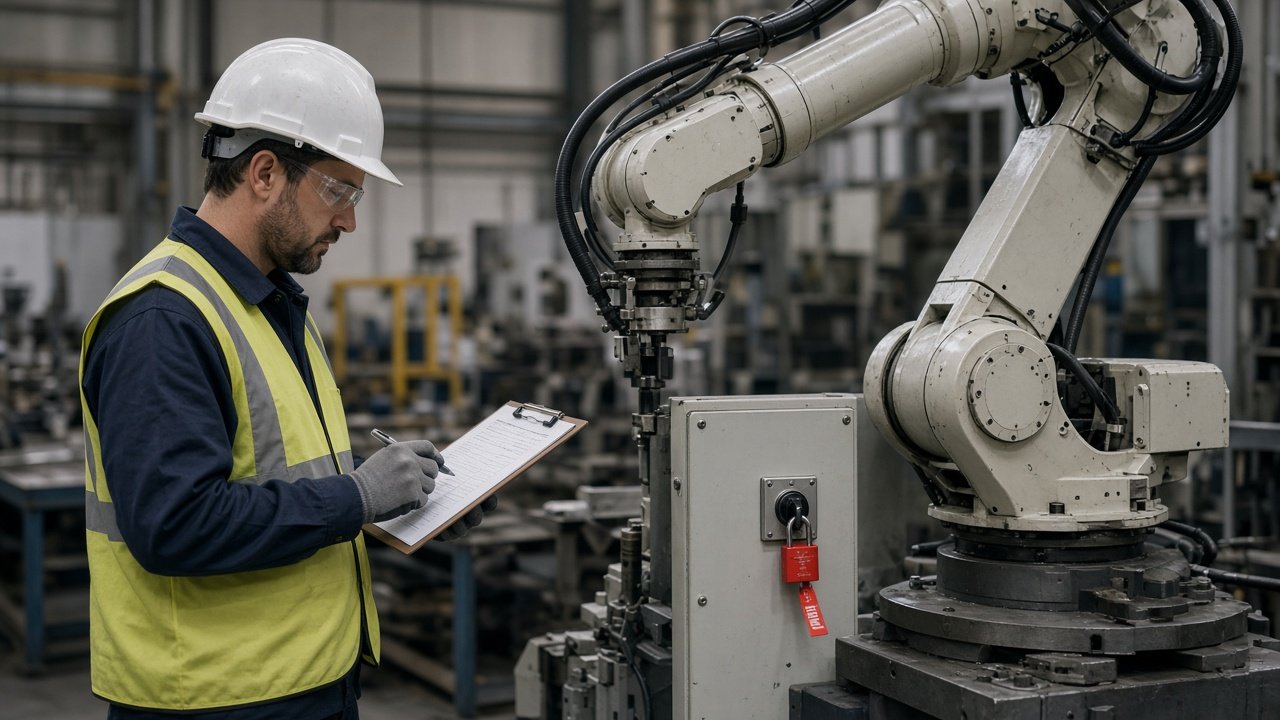
An emergency stop is not proof of energy isolation. For maintenance or blockage clearing, authorised personnel must follow the equipment-specific isolation procedure, address stored energy and verify the safe condition before intervention. Use durable industrial tags and labels so isolation points stay clearly identified. Plan how you will rescue someone without exposing another worker.
On a Dubai or Abu Dhabi site, check heat, dust, glare and ground conditions against manufacturer limits. Ask what happens if communications fail or a sensor becomes obscured. Do not bypass a safety function to finish a pour or recover lost time. Crews working near the robot zone still need the right PPE and safety items for the task.
What should your pre-start checklist include?
Your pre-start check should confirm that the approved task, trained people, protective systems and site conditions still match. Record who checked each item and resolve failures before starting. Use the following as a planning prompt, then adapt it with your integrator and HSE team to the machine and the project.
- Confirm the approved drawing revision, robot program and work limits.
- Check ground support, edges, overhead hazards, cables and hoses.
- Inspect safeguards and verify safety functions using the approved test procedure.
- Confirm access controls, pedestrian routes and coordination with other trades.
- Check operator competence, communication and shift-handover information.
- Agree inspection hold points, acceptance criteria and record ownership.
- Confirm fault response, isolation arrangements and emergency access.
Keep ordinary site hazards in the assessment too. Automation does not remove fire precautions; use your project plan alongside the UAE workplace fire safety checklist. If the process creates dust or fumes, specify suitable exposure controls. A portable fan alone is not proof of effective extraction or safe air. Where robotic work involves welding or cutting, follow your hot work permit controls as well.
Who is responsible if a construction robot makes a mistake?
A robot does not replace the people and organisations responsible for design, equipment integration, construction management and acceptance. Set those duties out in contracts and site procedures. If something goes wrong, the cause, contractual allocation and applicable law matter; a supplier’s promise of autonomy does not settle responsibility or legal liability.
Before procurement, ask your supplier who validates the installed system, who approves software changes and who investigates a near miss. Confirm access to operating logs and maintenance support. Name the people who can stop the work, approve a repair and accept the finished output.
Measure the pilot by accepted work, rework, setup time and safety performance, not a short demonstration video, and compare it with the proven ways to reduce industrial accidents you already use. If the trial needs extra supervision or frequent interventions, include those costs in your decision. You are buying a working process, not just a machine.
Frequently asked questions about construction robots in the UAE
The main questions are whether robots are already widespread, whether printing removes inspections and whether people can safely work nearby. The practical answers depend on the task and approved installation. Use these points to brief your team, then check project-specific requirements with your engineer, HSE lead and equipment integrator.
Are construction robots standard practice in the UAE?
No evidence reviewed establishes that they are standard practice across UAE sites. Dubai’s robotic-villa challenge demonstrates interest and testing, not universal adoption. Check actual project references and the scope of each installation rather than treating an announcement as proof of routine use.
Is Dubai’s robotic villa already finished?
The sources reviewed describe an announced challenge and development initiative, not a verified completed and occupied villa. Do not present promotional images as completion evidence. Confirm the latest status directly with Dubai Municipality before making a completion claim.
Does a 3D-printed villa still need an engineer?
Yes. Dubai’s 2023 resolution requires authorised structural design and engineering approval of relevant test results for printed load-bearing elements. A printer follows instructions; it does not replace the engineer’s role in checking the design and accepting the required evidence.
Can workers stand next to a cobot without barriers?
Not simply because it is called a cobot. The complete application needs risk assessment and validated safeguards. Tools, payloads, trapping points and nearby edges can change the risk. Any shared workspace must follow the assessed arrangement, not a marketing label.
Can a construction robot run overnight without people?
Do not assume so. Any unattended operation needs explicit manufacturer support, a suitable risk assessment and approved arrangements for access, fault response and emergencies. “Automatic” operation alone does not establish that leaving a machine unattended is safe or permitted.
Will robots replace site supervisors?
They may change a supervisor’s daily tasks, but they do not remove coordination, inspection or decision-making. You still need people to manage interfaces, investigate unexpected conditions and accept work. Plan training around those responsibilities rather than assuming supervision disappears.
Preparing an automated work area in Dubai, Abu Dhabi or elsewhere in the UAE? Request a quote from Cactus GGT for site safety equipment matched to your approved requirements. Share your equipment list and site conditions so you can discuss suitable options.