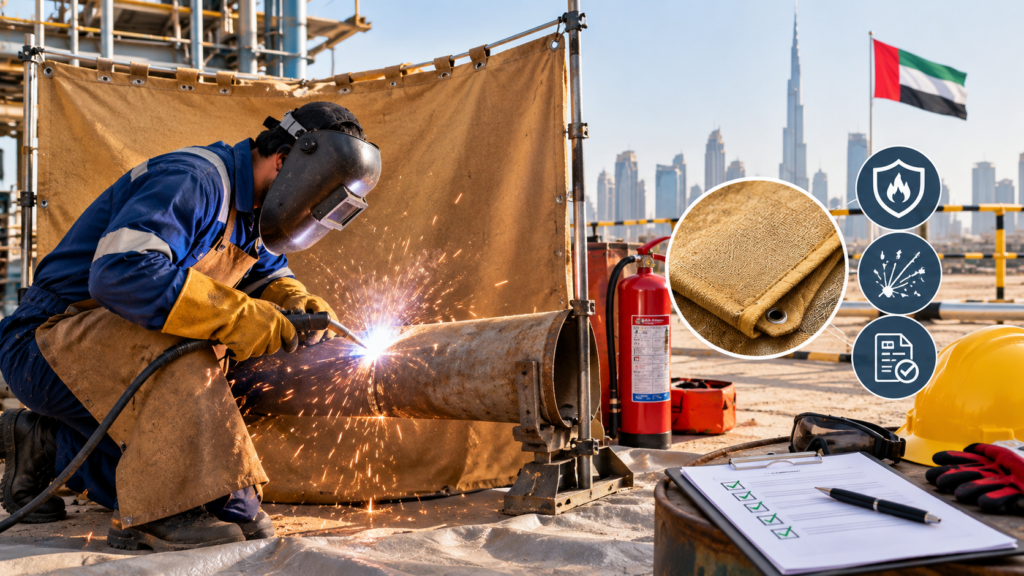
In the UAE, welding, cutting, grinding and similar work that creates sparks, flame or heat needs a controlled process. That usually means a signed hot work permit, a cleared work area, a trained fire watch, suitable fire extinguishers, and physical spark protection such as welding blankets. The permit is the paperwork. The blanket is one of the physical barriers that stops a spark from becoming a fire. You need both.
This guide explains how the permit process works in the UAE, who is responsible for what, and, most importantly for day-to-day work, exactly where to place welding blankets so the protection actually works.
This article is general guidance and is not legal advice. Always follow your site’s HSE rules, your client’s requirements and the instructions of the relevant authority.
What Counts as Hot Work?
Hot work is any activity that produces a source of ignition near material that can burn or explode. Common examples include:
- Welding (arc, MIG, TIG, gas)
- Flame cutting and plasma cutting
- Grinding and abrasive cutting
- Brazing and soldering
- Use of blowtorches and heat guns
- Any work with non-intrinsically safe equipment in a place with fire or explosion risk
The code for permit systems used in Abu Dhabi describes hot work in a similar way, as work where an ignition source is present or where non-intrinsically safe equipment is used and there is a risk of fire or explosion. It lists welding, cutting and grinding as examples.
Grinding surprises many people. It does not look as dramatic as welding, but a grinder throws a stream of hot sparks that can travel a long way.
Why Hot Work Needs Its Own Permit
Most workplace fires from welding do not start during the work. They start later, from a spark that dropped into a gap, a cable tray, a pile of rags or a floor opening, and smouldered quietly. This is why the process includes checks before the work, a watch during the work, and monitoring after it.
A permit forces five good habits:
- Someone other than the welder checks the area first.
- The risks and controls are written down.
- Everyone knows the start time, end time and limits.
- A fire watch is assigned.
- The job is formally closed when it is done.
Which Rules Apply in the UAE?
The UAE has a layered system. The exact rules depend on the emirate, the type of site and your client’s contract.
Abu Dhabi. The Abu Dhabi Occupational Safety and Health System Framework (OSHAD-SF) includes a dedicated code of practice for hot work operations, CoP 28.0 – Hot Work Operations, and a general code on permit to work systems (CoP 21.0). The hot work code says a hot work permit must be in place for work outside a designated area, and that the permit must follow the permit to work code. adphc
Dubai and other emirates. Fire safety on premises is governed through the civil defence authorities and the UAE Fire and Life Safety Code. See the Dubai Civil Defence website for current information, and check the authority in your own emirate.
International references. Many UAE projects, especially in oil and gas, also work to international practice such as NFPA 51B, the standard for fire prevention during welding, cutting and other hot work, and the US OSHA welding and cutting rule (1910.252). These are often written into client contracts.
Your client’s own rules. Large operators often add their own permit systems. If your contract says the client’s rules apply, those usually go further than the minimum.
Because rules and documents are updated, always download the latest versions before you plan a job. Do not rely on an old copy from a previous project.
Designated Hot Work Areas: When a Permit May Not Be Needed
Some sites have a permanent, purpose-built hot work area such as a fabrication workshop. The Abu Dhabi code describes a designated hot work area as a permanent location designed for hot work, and says that such areas do not normally require a permit to perform hot work. These areas still need to be kept clean, clear of combustibles and fitted with the right fire protection.
Outside those areas, which means most site work, repairs, shutdowns and maintenance, a permit is the rule.
Who Does What: The Three Key Roles
A hot work permit works only if each person understands their job.
1. The Permit Issuer (Authoriser)
This person inspects the area, confirms controls are in place and signs the permit. They must be competent and authorised by the site. As a general principle, the person doing the work should not issue their own permit.
2. The Hot Work Operator (Welder or Cutter)
The operator performs the work inside the limits written on the permit. They are responsible for their equipment, their PPE and stopping if conditions change.
3. The Fire Watch
The fire watch has one job: watch for ignition. They do not hold the workpiece, fetch tools or do other tasks. They must be trained in using fire extinguishers and know how to raise the alarm. The Abu Dhabi code requires a continuous fire watch during the work and for a period afterwards, and requires the permit to be signed off when the job is finished. Check the code and your permit for the exact post-work period. adphc
On multi-level work, one fire watch is often not enough. If sparks can fall to floors below or pass through openings, someone must watch those areas too.
The Hot Work Permit Process Step by Step
Here is a practical process that fits most UAE sites. Adjust it to your own permit form.
Step 1: Ask if hot work is really necessary. Can the job be done cold, for example with mechanical fixing or pre-fabrication in a workshop? Removing the hazard is always better than controlling it.
Step 2: Plan the job. Define the location, task, equipment, start and end time, and the people involved.
Step 3: Inspect the area. Look up, down and around. Check floors, walls, ceilings, ducts, cable trays, pipes and any nearby rooms.
Step 4: Remove or protect combustibles. Move flammable and combustible materials away. A commonly used distance in international practice is about 11 m (35 ft) around the work, which both NFPA and OSHA guidance refer to. Anything that cannot be moved must be shielded.
Step 5: Test the atmosphere if needed. If there may be flammable gas or vapour, test before and during the work. Hot work inside a tank, vessel or confined space is also confined space entry and needs its own permit.
Step 6: Install physical protection. Place welding blankets, screens and covers. The next section explains how.
Step 7: Set up fire fighting equipment. Put suitable extinguishers close to the work. Make sure they are the right type for the material nearby.
Step 8: Issue the permit. The issuer checks everything, then signs. All parties sign to confirm they understand it.
Step 9: Carry out the work with the fire watch in place. Stop if conditions change, such as a gas smell, an alarm or new people entering the area.
Step 10: Monitor after the work. Continue watching for the required period, and inspect the area, including hidden places.
Step 11: Close the permit. Sign off when the area is confirmed safe. Secure the site at the end of the permit period.
Our UAE workplace fire safety checklist can help you cover wider site risks around this process.
The Role of Welding Blankets in Spark Protection
A permit says what must be done. A welding blanket is one of the tools that does it.
Welding blankets are heat- and spark-resistant covers, usually made from a woven high-temperature fabric such as fibreglass, sometimes with a coating. They are used to:
- Catch sparks, spatter and slag so they cannot reach combustible material
- Shield nearby equipment, cables, pipes and finished surfaces
- Create temporary screens that contain sparks within a work zone
- Protect floors, grating and openings from falling hot particles
They do not make an unsafe job safe on their own. A blanket will not fix a missing permit, a missing fire watch, or a pile of flammable material left beside the work. Think of it as one layer in a set of layers.
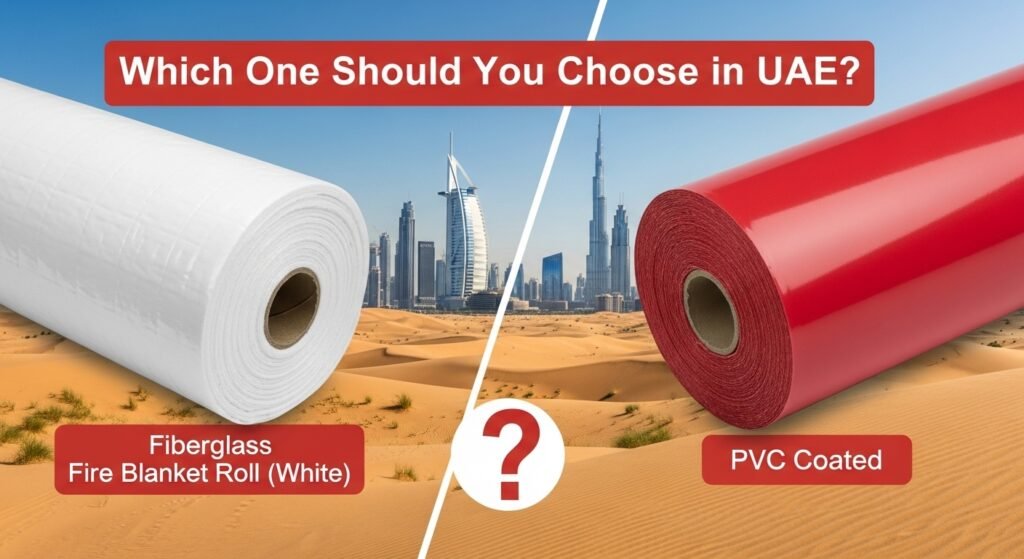
If you want more on how fire blankets differ in materials and use, read our fire blanket buying guide for industrial sites, and see the product details on our fire blanket roll page.
Where to Place Welding Blankets: A Practical Placement Guide
This is the part most guides skip. A blanket in the wrong place does nothing.
Horizontal Cover (Under and Around the Work)
Lay blankets on floors, platforms or grating below the work to catch falling sparks. Cover the whole area where sparks can land, not only the spot directly under the weld. Sparks bounce and roll.
Vertical Screens (Beside the Work)
Hang blankets from stands, frames or hooks to make a screen around the work. This stops sparks flying sideways into walkways, other trades or stored materials.
Draped Protection (Over Equipment)
Drape blankets over cables, hoses, valves, instruments, painted surfaces and anything that cannot be moved. Make sure the blanket reaches fully over the item and is secured so it cannot slip.
Opening and Gap Cover
Sparks love gaps: floor penetrations, cable trays, pipe sleeves, door gaps and wall openings. Cover or seal openings so sparks cannot drop through to another level or room. The fire watch must still check the other side.
Pipe and Duct Work
When welding on pipes close to walls or ceilings, put a blanket between the work and the surface behind it. Remember that heat can conduct through metal and ignite something on the far side.
Overlap and Fixing
Overlap adjoining blankets so there is no seam for sparks to enter. Fix them so wind, vibration or movement does not shift them. Do not leave loose edges where sparks can lodge underneath.
Choosing the Right Welding Blanket
Not every blanket suits every job. Check these points before you buy.
Temperature and spark rating. Ask for the maximum working temperature and what kind of exposure it is designed for, such as sparks and spatter or heavier molten metal. Light-duty blankets can burn through under heavy cutting.
Material and coating. Fibreglass-based fabrics are common for hot work. Coatings can improve durability and handling but vary in performance. Ask the supplier for the exact construction.
Thickness and weight. Thicker blankets handle heavier slag. Thinner ones are easier to drape and store.
Size and format. Rolls are flexible because you cut to fit. Pre-cut blankets with eyelets are quicker for repeated set-ups. Choose a size that gives overlap beyond the work area.
Test information. Ask which tests or standards the product has been assessed against, such as spatter-resistance methods in ISO standards. A good supplier can show a data sheet. You can browse the ISO catalogue for relevant standards.
Clean fibres and handling. Some fibreglass fabrics can irritate skin. Use gloves when cutting and handling, and follow the supplier’s advice.
Condition. Inspect before each use. Retire blankets with burn holes, thin patches, contamination or heavy damage.
Remember that a household-type fire blanket for extinguishing small fires and a welding blanket for spark protection are used for different purposes. Make sure you buy the one that fits the task.
Hot Work PPE: Do Not Forget the Welder
Spark protection for the site is half the story. The people also need protection:
- Welding helmet or face shield with the correct shade
- Flame-resistant coveralls (not synthetic fabrics that melt)
- Leather gloves and safety boots
- Hearing and respiratory protection where needed
- Good ventilation and fume control
Summer heat adds another risk. Heavy PPE in 40°C+ conditions increases heat stress, so plan breaks and shade, and follow the working-hour rules published by the UAE Ministry of Human Resources and Emiratisation.
Common Hot Work Mistakes (And How to Avoid Them)
- Treating the permit as a signature exercise. The permit only works when the area is actually inspected.
- A fire watch who is also doing a task. A watch with two jobs is not a watch.
- Covering only the spot under the weld. Sparks travel and bounce.
- Ignoring the other side of the wall or floor. Fires start where nobody is looking.
- Leaving too early. Smouldering fires can appear well after the last spark.
- Using the wrong blanket. A light cover on heavy cutting burns through.
- Reusing damaged blankets. Holes and thin areas fail exactly when needed.
- Not testing for gas. In areas where vapour may be present, a spark can cause an explosion.
- Poor communication between trades. Other teams working nearby may not know hot work is happening.
- Not closing the permit. An open permit leaves unclear responsibility.
Hot Work Pre Start Checklist
Use this as a quick reference. It does not replace your site’s permit form.
| Check | Done |
|---|---|
| Hot work really necessary? Cold alternative considered? | ☐ |
| Valid permit issued by an authorised person | ☐ |
| Area inspected above, below and on all sides | ☐ |
| Combustibles removed or protected | ☐ |
| Gas test done where required | ☐ |
| Welding blankets and screens placed and overlapped | ☐ |
| Openings, trays and gaps covered | ☐ |
| Fire extinguisher of the right type within reach | ☐ |
| Trained fire watch assigned and in position | ☐ |
| Operator wearing correct PPE | ☐ |
| Nearby teams informed | ☐ |
| Post-work watch period agreed | ☐ |
How to Plan Ahead for 2027 Projects
If you are budgeting or planning work for the coming year, a few steps now save trouble later.
- Check your documents. Download the current OSHAD codes, civil defence requirements and client rules, and note their versions.
- Train your people. Make sure permit issuers, operators and fire watch personnel have current training.
- Stock the right protection. Keep enough blankets, screens and extinguishers for peak shutdown periods, and replace worn items.
- Standardise your set-ups. Use the same placement approach on every job so crews know what to expect.
- Keep records. Closed permits, inspection records and training logs help during audits and investigations.
- Review after incidents and near misses. Small events show where your controls are weak.
For buying, see how local suppliers can help you cut cost in our article on buying industrial supplies direct in the UAE.
Frequently Asked Questions
Do I need a permit for hot work in the UAE?
In most cases outside a designated hot work area, yes. In Abu Dhabi, the OSHAD hot work code requires a permit to work for hot work outside designated areas. Other emirates and clients have their own rules, so confirm with your site HSE team.
What is a fire watch?
A trained person whose only task is to watch for fires during the work and for the required time afterwards. They know how to use extinguishers and raise the alarm.
How long must the fire watch continue after welding?
It depends on the applicable code and your permit. International guidance commonly uses periods of 30 to 60 minutes or more. Follow the requirement that applies to your site and use the longer period when risk is higher.
Does a welding blanket replace a hot work permit?
No. A blanket is a physical control. The permit is the management control. You need both.
Can I use a normal fire blanket for welding?
Check the product’s intended use. Welding blankets are made to resist sparks and spatter. Ask your supplier whether the product you plan to use suits your type of work.
What is the minimum distance for combustibles?
International practice often uses about 11 m (35 ft) as a clearance radius, with anything inside that distance removed or protected. Your site rules may be stricter.
Is grinding hot work?
Yes. Grinding throws sparks and is treated as hot work in permit systems.
How often should welding blankets be replaced?
Inspect before each use. Replace them when you see burn-through, thin patches, contamination or damage.
Protect Your Site With the Right Spark Protection
Choosing the right welding blanket is easier when you know what the job involves. Tell us the type of work, the typical spark or slag load and the area you need to cover, and our team at Cactus General Global Trading in Abu Dhabi will recommend a suitable option. See our fire blanket roll or visit our shop to request a quote.