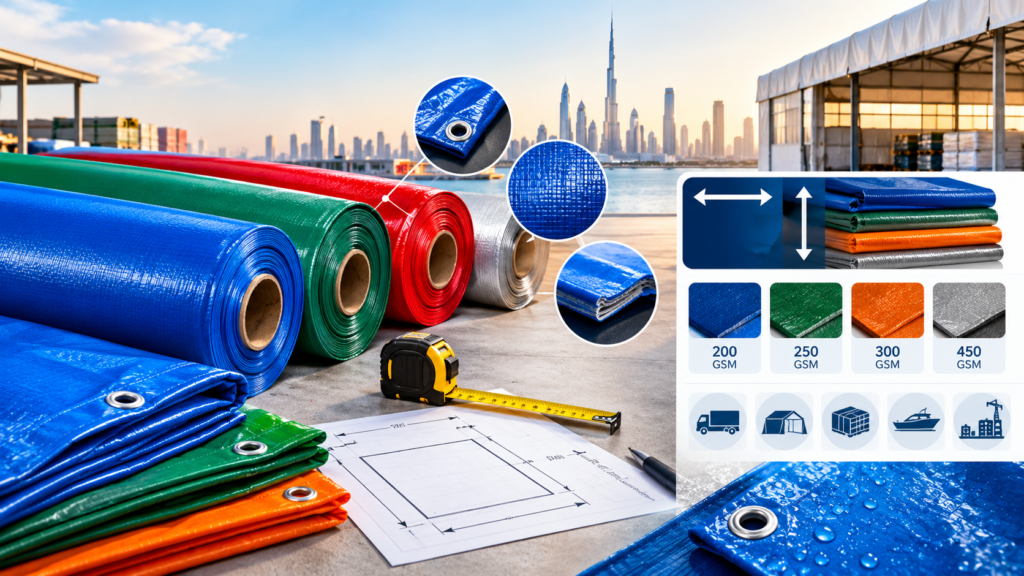
To choose the right PVC tarpaulin, measure what you need to cover, add twice its height plus a 2 ft overlap on each side dimension, and round up to the next standard size. Then pick the GSM based on how long the sheet will stay outdoors. In the UAE, a sheet that will sit in the sun for weeks or months should generally be 200 GSM or heavier, because heat and UV break down thin material quickly.
That is the short version. The rest of this guide explains the reasoning, with a formula, worked examples, size and GSM charts, and a buying checklist you can use whether you are covering a single pallet or a full construction yard.
Why Getting the Size Wrong Is So Expensive
Most buyers choose a tarpaulin the way they choose a bucket: they look at the price and grab the one that seems about right. The problem shows up a week later.
If the sheet is too small, the edges of your material stay exposed. Rain, dust and sun reach exactly the parts you wanted to protect. If the sheet is too large, you pay for fabric you do not need, and the extra material flaps in the wind, which strains the eyelets and wears the sheet out faster. If the GSM is too low, the sheet may crack or tear long before you expected.
Any of these mistakes means buying twice. That is why a few minutes of measuring before ordering is the cheapest saving you can make.
Why the UAE Needs a Different Approach
Tarpaulin advice written for cooler or wetter countries does not always work here. Three local conditions change the rules.
Heat. Summer temperatures across the Emirates regularly pass 45°C, and surfaces in direct sun get much hotter than the air. You can check current conditions with the UAE National Center of Meteorology. Heat softens and ages PVC coatings over time, so thin sheets lose flexibility sooner.
UV exposure. The sun is strong almost all year. UV is one of the main reasons outdoor fabrics fade, go brittle and crack. A sheet with UV treatment and enough thickness lasts noticeably longer than a basic one.
Wind and dust. Open sites in Abu Dhabi, Mussafah, industrial zones and desert-edge projects see strong gusts and fine dust. A loosely fixed sheet turns into a sail. Tie-down points and overlap matter more than most people think.
On top of that, sudden heavy rain in winter means the same sheet often has to do both jobs: block sun for months and shed water in a short storm. Our rain protection checklist covers that side in more detail.
Understanding Tarpaulin Sizes: What the Numbers Mean
Before using any chart, you need to know three things about how sizes are quoted.
1. Units. Many tarpaulin sizes in the Gulf market are quoted in feet, for example 18 × 18 ft, while some suppliers and engineers work in metres. Always confirm the unit in writing before you order. As a rough conversion, 1 foot is about 0.3048 metres, so 18 ft is about 5.5 m and 40 ft is about 12.2 m.
2. Cut size versus finished size. The size printed on a label is often the cut size. After hemming and reinforcing the edges, the finished sheet can be slightly smaller. For tight jobs, ask the supplier for the finished dimensions or keep a small safety margin.
3. Length and width. A sheet marked 18 × 18 is a square. If your load is long and narrow, a rectangular sheet can fit better than a square one, and ordering a custom size can be cheaper than buying a much larger standard sheet.
For a general background on what tarpaulins are and how they have been used, see the overview on Wikipedia.
Step 1: Measure Your Cover Area
Measure the item or stack you want to protect in three directions:
- L = length
- W = width
- H = height
Use the highest and widest points. If the stack is uneven, measure the largest dimensions. Photograph it with a tape measure in the frame so you can send the details to your supplier.
Step 2: Use the Cover Formula
Use these two lines:
Required length = L + (2 × H) + 2 ft overlap
Required width = W + (2 × H) + 2 ft overlap
The idea is simple. The sheet must go over the top, hang down both sides to the ground, and still leave a little extra to tie off. The 2 ft overlap is the tie-down allowance. Without it, wind finds the gap and lifts the sheet.
Worked Example 1: A Single Pallet
A pallet load measures 6 ft long, 4 ft wide and 4 ft high.
- Length: 6 + 8 + 2 = 16 ft
- Width: 4 + 8 + 2 = 14 ft
You need at least 16 × 14 ft. A standard 18 × 18 ft sheet fits with a comfortable margin.
Worked Example 2: A Building Material Stack
A stack of blocks measures 20 ft long, 15 ft wide and 6 ft high.
- Length: 20 + 12 + 2 = 34 ft
- Width: 15 + 12 + 2 = 29 ft
You need at least 34 × 29 ft. A 40 × 40 ft sheet covers it.
Worked Example 3: A Large Yard Stack
A bulk stack measures 44 ft long, 40 ft wide and 6 ft high.
- Length: 44 + 12 + 2 = 58 ft
- Width: 40 + 12 + 2 = 54 ft
You need at least 58 × 54 ft. A 60 × 60 ft sheet is the right choice.
Worked Example 4: When One Sheet Is Not Enough
If your calculation shows you need more than the largest available sheet, do not stretch a smaller one. Overlap two sheets by at least a foot or two, with the upwind sheet lying on top so wind and water run over the joint and not into it. Fix both sheets firmly along the overlap.
Step 3: Compare With the Size Chart
Here is a quick reference for common standard sizes. You can see the options we supply on our PVC tarpaulin sheets page.
| Size (ft) | Area (sq ft) | Area (m²) | Typical use |
|---|---|---|---|
| 18 × 18 | 324 | about 30 | Pallets, tool stores, small stacks, pickup loads |
| 40 × 40 | 1,600 | about 149 | Building materials, scaffolding, generators, truck loads |
| 60 × 60 | 3,600 | about 334 | Large yards, bulk stock, heavy machinery |
Simple rule of thumb: small sheets suit single items and short-term jobs. Mid-size sheets suit most construction and warehouse needs. Large sheets suit yards and big equipment where one continuous cover is safer than several joined sheets.
What Is GSM and Why Does It Decide Lifespan?
GSM stands for grams per square metre. It measures the weight of the fabric, and in practice it is the quickest way to compare how heavy-duty two tarpaulins are. A higher GSM usually means a thicker, stronger sheet that resists tearing and weather longer. It also means more weight to carry, fold and fix.
GSM is not the only quality factor. Two sheets with the same GSM can perform differently if the base fabric, coating quality and UV treatment are different. Still, if everything else is equal, GSM is the first number to check.
Typical GSM Ranges and Where They Fit
| GSM (typical range) | Best for | Outdoor life in UAE sun |
|---|---|---|
| 100–150 | Short-term cover, dust protection, indoor use, temporary jobs | Short, often only weeks |
| 150–250 | General construction, storage, material cover | Medium, check regularly |
| 250 and above | Long-term site cover, oil and gas yards, windy locations, repeated use | Long, if tied and stored properly |
These are common industry ranges and not exact promises. Always check the actual specification of the product you are buying. For example, our listed 40 × 40 ft sheet is rated at 200–250 GSM.
How to Decide Quickly
Ask yourself one question: how long will this sheet stay outside?
- A few days: a lighter sheet is fine.
- A few weeks: go to mid-range GSM.
- Months, or repeated use across projects: choose heavy duty and treat it as equipment, not a disposable item.
A heavier sheet that lasts three times as long is often cheaper per month than a light one you replace again and again.
PVC, PE or Canvas: Which Material Suits You?
Size and GSM are only part of the choice. Material changes how the sheet behaves.
PVC-coated tarpaulin. Strong, waterproof and flexible. It handles heavy use, sun and repeated folding well, and it is a common choice for construction, transport and industrial covers.
PE (polyethylene) tarpaulin. Light and low cost. It works for short-term or light-duty cover but usually ages faster under strong sun.
Canvas tarpaulin. Breathable and traditional, which helps when covering items that need airflow. It is generally heavier and usually needs more care to avoid damp problems.
For most outdoor industrial cover in the UAE, PVC is the practical middle ground between durability and cost. If you are not sure which suits your cargo, tell us what you are covering and we will advise.
Features That Matter as Much as Size
Once size and GSM are settled, check these details. They separate a good sheet from a disappointing one.
Eyelets (grommets). Look for reinforced eyelets spaced evenly along the edges. Weak or widely spaced eyelets tear out under wind load.
Hemming and edge reinforcement. Folded and stitched or welded edges stop fraying and spread the load.
Seam quality. On large sheets, seams should be welded or well stitched so water does not enter through them.
UV treatment. Ask whether the sheet is UV stabilised. This is one of the biggest factors for lifespan here.
Colour. Lighter or reflective colours generally absorb less heat than dark ones, which can help when covering heat-sensitive goods. Colour choice can also be useful for site identification.
Fire performance. A normal PVC tarpaulin is not a fire blanket. If there is welding or cutting nearby, a fire-retardant specification is a different requirement, and sparks should be controlled with a proper fire blanket. Read our guide on fire blanket rolls for hot work before you plan the work area.
Choosing by Industry
Construction Sites
Sites need cover for cement, blocks, sand, scaffolding and equipment. Mid to heavy GSM is usual because sheets are moved and re-fixed often. Buy more than one size so you do not have to improvise.
Oil and Gas
Large operators often need documented specifications and approved suppliers. Heavy GSM, clear technical data and proper traceability matter here. Read our article on ADNOC approved tarpaulin suppliers in the UAE for what approval means in practice.
Warehousing and Logistics
Truck loads and open storage need cover that can be put on and taken off quickly. Check the sheet weight, because a heavy sheet is slow to handle with a small crew.
Marine and Port Areas
Salt air and strong wind are harder on fabric and fittings. Choose heavy-duty sheets with strong eyelets and rinse them after exposure when possible.
Events and Temporary Shade
For short events, lighter GSM can be enough, but wind safety still comes first. Never use a loose sheet over people without a proper support structure.
Seven Common Mistakes Buyers Make
- Comparing only the price per sheet. Compare price per square metre together with GSM.
- Skipping the overlap. No tie-down margin means wind will lift the edges.
- Using one size for every job. Measure each job and match it.
- Ignoring UV. Basic sheets fade and crack early in strong sun.
- Dragging sheets over rough ground. This tears the coating before the sheet has done any work.
- Folding while wet. Trapped moisture causes odour, mould and weakening.
- Covering hot items directly. Hot machinery or fresh welds can damage the sheet and create a fire risk. Keep a safe gap and use the right protection.
How to Fix a Tarpaulin Properly
A good sheet still fails if it is fixed badly. Follow these basics:
- Use all eyelets, not just the corners.
- Pull the sheet snug, but do not stretch it so tight that it strains. Some slack is better than a drum-tight sheet in strong wind.
- Use rope, bungee or ratchet straps rated for the load, and tie to solid anchor points.
- Round off sharp corners of the load or pad them so they do not cut the fabric.
- Slope the cover so water runs off and does not pool. Pooled water is heavy and can tear the sheet.
- Check the fixing after any storm and at regular intervals.
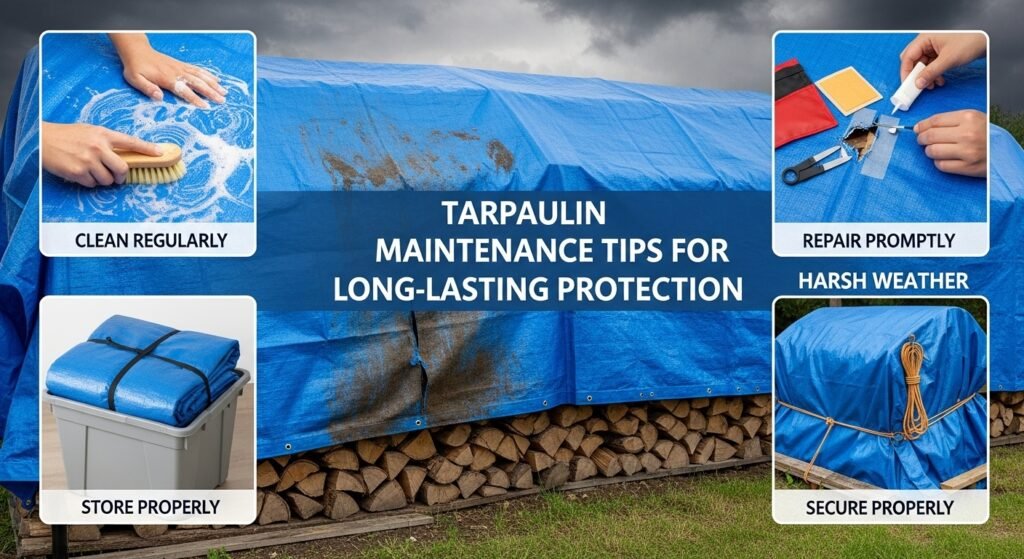
For day-to-day care and cleaning, read our tarpaulin maintenance tips, and for creative and lesser-known applications see our post on the top uses of tarpaulin in the UAE.
Storing Your Tarpaulin Between Jobs
Clean off dust and dirt, let the sheet dry fully, fold it loosely and store it in a cool, shaded, dry place. Avoid leaving it in a hot vehicle or in direct sun when not in use. Good storage can add months to the life of the sheet.
A Simple Checklist for Comparing Quotes
When you ask for quotations, make sure each supplier gives you the same information. If a quote leaves something out, ask.
- Material type (PVC, PE or canvas)
- GSM, and whether it is nominal or tested
- Exact size, and cut versus finished
- UV treatment
- Eyelet spacing and type
- Seam type
- Colour options
- Lead time and delivery to your site
- Whether bulk pricing is available
Buying direct from a local supplier can also reduce cost, as explained in our article on how UAE businesses cut costs by buying industrial supplies direct.
For technical reference, you can browse the standards catalogues of ISO and ASTM, which cover coated fabrics and related testing methods. Ask your supplier which test standards, if any, apply to the product you plan to buy.
Safety Note for Summer Work
If your crew handles large sheets outdoors in summer, plan the work around the official working-hour rules published by the UAE Ministry of Human Resources and Emiratisation. Large sheets catch wind and need more than one person to place safely. For wider site safety ideas, see our UAE workplace safety checklist.
Frequently Asked Questions
What size PVC tarpaulin do I need?
Measure the length, width and height of the item. Then use: length + (2 × height) + 2 ft, and the same for width. Choose the next standard size above your result.
Is an 18 × 18 ft tarpaulin enough for a pallet?
For most single pallets and small stacks, yes. Use the formula to confirm, especially if the load is tall.
What GSM is best for the UAE?
For long-term outdoor use, 200 GSM or higher is a safer choice because of heat and UV. For short jobs, lighter sheets can work.
Does a higher GSM always mean better quality?
Not always. GSM shows weight, but coating quality, UV treatment and stitching also decide how long a sheet lasts.
Is PVC tarpaulin fully waterproof?
Good PVC tarpaulins are waterproof, but water can still get in through open edges, poor seams or sagging areas that collect water.
Can I order a custom size?
Yes, send us your measurements and we will advise on the best option and lead time.
How long does a PVC tarpaulin last outdoors in the UAE?
It depends on GSM, UV treatment, fixing and care. Heavy-duty sheets that are tied well and stored properly last far longer than thin ones left loose in the sun.
Can I use a tarpaulin near welding?
A normal tarpaulin is not designed for hot work. Use a proper welding fire blanket and keep combustible material away. See our fire blanket roll page.
Get the Right Tarpaulin the First Time
If you are still unsure, send us the measurements of what you need to cover, how long it will stay outdoors and where the site is. Our team at Cactus General Global Trading in Abu Dhabi will recommend the size and GSM that fit. Browse the full range on our PVC tarpaulin sheets page or visit our shop to request a quote.