In 2026, UAE Civil Defence fire safety enforcement is more active and more consequential than at any point in the country’s regulatory history.
Following a series of high-profile industrial fires across the GCC over the past three years, UAE authorities have significantly tightened inspection frequency, expanded the categories of premises subject to mandatory compliance review, and increased the penalties for businesses found operating without valid fire safety certification.
For facilities managers, HSE officers, and business owners in Abu Dhabi, Dubai, Sharjah, and the Northern Emirates, this means one thing: a checklist-and-evidence approach to fire safety is no longer a best practice it is a legal necessity.
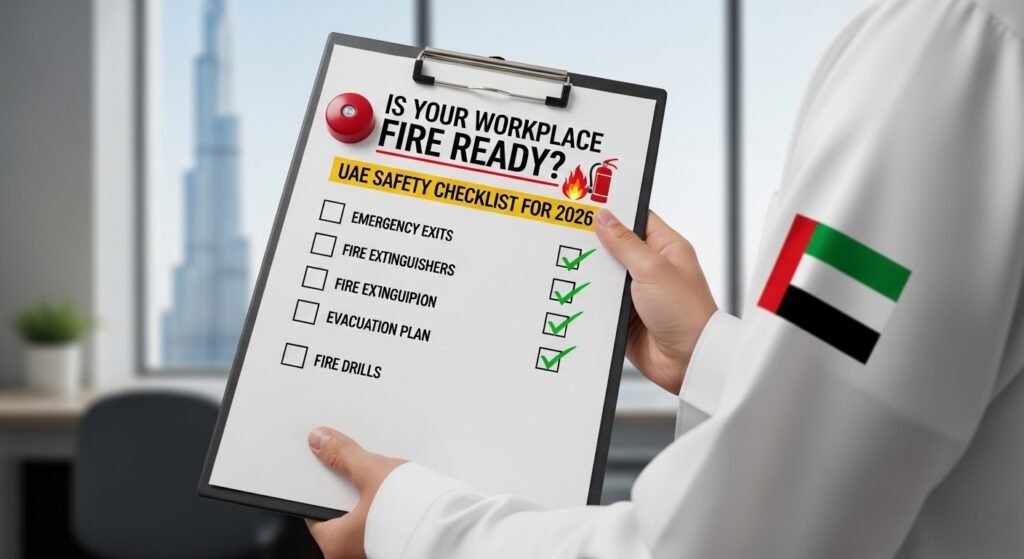
This guide gives you a complete, practical UAE fire safety checklist for 2026, aligned with UAE Civil Defence requirements, NFPA standards, and the UAE Labour Law provisions that apply to workplace fire safety obligations. Work through it section by section, document your compliance at each point, and you will be prepared for any unannounced inspection.
UAE Fire Safety Legal Framework: What Governs Compliance in 2026
Before working through the checklist, it is important to understand which regulations actually apply to your premises. UAE fire safety compliance draws from four primary sources:
UAE Civil Defence Law (Federal Law No. 9 of 2006) establishes the authority of the General Directorate of Civil Defence to set, inspect, and enforce fire safety standards across all Emirates. Civil Defence issues the fire safety certificate (shahadat al salama) that all commercial and industrial premises must hold.
Local Emirate Authority Requirements Abu Dhabi Civil Defence (ADCD), Dubai Civil Defence (DCD), and their equivalents in Sharjah, RAK, Fujairah, UAQ, and Ajman each issue their own technical circulars that supplement the federal framework. Requirements can differ between Emirates on specific items such as sprinkler thresholds and alarm zone configurations.
NFPA Standards particularly NFPA 10 (portable fire extinguishers), NFPA 72 (fire alarm systems), and NFPA 101 (life safety code) are adopted by reference across UAE Civil Defence technical requirements and form the technical basis for most compliance decisions.
UAE Labour Law (Federal Decree-Law No. 33 of 2021) places a direct legal duty on employers to provide a safe working environment, which includes adequate fire protection measures for all employees regardless of nationality or visa status.
Understanding this framework matters because non-compliance is not just a technical failure it is a legal one, with penalties that can include fines up to AED 50,000, forced business suspension, and in cases involving injury or fatality, criminal prosecution of the responsible individual.
For further background on fire safety standards relevant to UAE industrial settings, our fire safety myths debunked UAE guide clears up common misunderstandings that put businesses at risk during inspections.
The Complete UAE Workplace Fire Safety Checklist for 2026
Work through each section systematically. Mark each item as compliant, non-compliant, or requiring review, and assign a responsible person and a deadline for any remediation action.
Section 1: Fire Detection & Alarm Systems
- A UAE Civil Defence-approved automatic fire detection system is installed and covers all occupied areas, plant rooms, and storage zones
- Smoke detectors are positioned in accordance with NFPA 72 spacing requirements (maximum 9.1m radius from any point in open areas)
- Heat detectors are installed in kitchens, plant rooms, and areas where smoke detectors would generate false alarms
- Manual call points (break-glass units) are located at every exit and at intervals not exceeding 30 metres of travel distance
- The fire alarm control panel is accessible, clearly labelled, and has a current inspection certificate
- The alarm system has been tested within the last 12 months by an approved UAE service contractor, with a test certificate on file
- Audible alarm output is sufficient to be heard clearly in all areas of the premises, including during normal operational noise levels
- The system is connected to UAE Civil Defence monitoring where required by your premises category
Why this matters in 2026: Civil Defence inspectors now routinely request the last two years of fire alarm service records. A system that has not been tested and certified by an approved contractor regardless of whether it physically works is treated as non-compliant.
Section 2: Fire Suppression & Extinguisher Placement
- Portable fire extinguishers are provided at a maximum travel distance of 25 metres to the nearest unit for Class A risks (ordinary combustibles)
- Extinguisher type matches the fire risk: CO2 for electrical panels and server rooms, dry powder or foam for flammable liquid stores, water-mist or water for general office and storage areas
- Extinguisher quantity meets the NFPA 10 requirement: minimum one unit per 200–300 square metres of floor area, adjusted upward for high-risk areas
- All extinguishers are wall-mounted or on approved stands not stored on the floor or in cupboards
- Extinguisher inspection tags are current (monthly visual check and annual service by an approved contractor)
- A fixed suppression system (sprinklers, gaseous suppression, or foam deluge) is installed where required by your premises classification under UAE Civil Defence technical requirements
- Sprinkler heads are unobstructed no racking, shelving, or stored materials within 45cm below sprinkler deflectors
- Fire hose reels are installed, tested, and accessible within the required coverage distances
Product note: Our PVC-coated fiberglass fire blankets and fiberglass fire blanket rolls are mandatory additional fire suppression tools in commercial kitchens, welding areas, and laboratories under UAE Civil Defence guidelines. Fire blankets must be accessible within arm’s reach of the risk area and replaced immediately after any use. For a full breakdown of fire blanket specifications and compliance requirements, our fire blanket guide for industrial sites covers everything procurement teams and HSE officers need to know.
Section 3: Emergency Exit Routes & Signage
- All emergency exit doors open in the direction of travel (outward-opening) and are not locked or obstructed at any time during working hours
- Emergency exit routes are marked with UAE Civil Defence-approved illuminated signage at every decision point and at maximum 20-metre intervals along corridors
- Emergency lighting is installed above every exit door and along escape routes, with a minimum 1-hour battery backup duration
- Exit routes are free from stored materials, equipment, and obstructions at all times this is the single most commonly cited violation during UAE Civil Defence inspections
- Travel distance from any point in the building to the nearest exit does not exceed the limits in your Civil Defence-approved fire safety plan (typically 30–45 metres depending on occupancy type)
- Assembly points are clearly marked outside the building with approved signage, and their locations are communicated to all staff
- All fire doors are self-closing, undamaged, and not wedged open fire doors held open with extinguishers or furniture are an automatic inspection failure
Section 4: Staff Fire Training & Warden Designation
- At least one designated fire warden is appointed per floor or work zone, with written appointment records
- All fire wardens have completed a UAE Civil Defence recognised fire warden training course within the last two years, with certificates on file
- All employees including recently joined staff and contractors have received basic fire safety awareness induction covering alarm recognition, evacuation procedure, and assembly point location
- Fire evacuation drills have been conducted at least once in the past 12 months, with a written drill record including date, time, total evacuation time, and any deficiencies noted
- Fire safety training records are maintained and available for Civil Defence inspection on request
- Non-Arabic speaking employees have received fire safety instructions in a language they understand this is a specific Civil Defence requirement for diverse UAE workforces
Why training documentation is critical: Civil Defence inspectors increasingly ask for training records as part of routine inspections, not just post-incident investigations. Missing records are treated as evidence of non-compliance even if the training actually occurred.
For a broader framework on building a safety culture across your UAE operation, our guide on 10 proven ways to improve workplace safety covers training, equipment, and procedural elements together.
Section 5: Flammable Material Storage & Labelling
- All flammable liquids, gases, and combustible materials are stored in UAE Civil Defence-approved storage areas separated from ignition sources, electrical equipment, and occupied workspaces
- Flammable material stores have appropriate ventilation to prevent vapour accumulation
- Hazardous material quantities on the premises do not exceed the thresholds in your Civil Defence permit excess quantities require a separate storage licence
- All containers are correctly labelled with GHS-compliant hazard labels in Arabic and English
- Safety Data Sheets (SDS) for all hazardous materials are available on site and accessible to staff
- LPG cylinders are stored upright, chained, in ventilated outdoor cages not inside buildings or plant rooms
Section 6: Electrical Safety & Hot-Work Controls
- Electrical distribution boards are clearly labelled, accessible, and have a minimum 1-metre clearance maintained in front of them at all times
- A Permit to Work (PTW) system is in operation for all hot work welding, cutting, grinding including fire watch requirements after work completion
- Electrical installations have been inspected and certified by an approved UAE electrical contractor within the required period
- No temporary electrical arrangements (extension cables used as permanent wiring, overloaded sockets, uncovered junction boxes) are present on the premises
- Explosion-proof electrical equipment is installed in all areas classified as hazardous zones under ATEX/IECEx standards oil and gas facilities, paint stores, chemical mixing areas, and similar
- For hazardous area operations, ATEX-certified portable equipment including lighting and hand tools is used exclusively standard consumer-grade equipment in hazardous zones is a critical non-compliance
For UAE businesses operating in classified hazardous areas, our best brands for explosion-proof tools guide identifies the certified product lines that satisfy Civil Defence and HSE requirements. Additionally, maintaining and inspecting industrial electrical equipment covers the inspection intervals and documentation required to stay compliant between formal audits.
Section 7: Documentation & Civil Defence Certification
- A valid fire safety certificate (shahadat al salama) is displayed on the premises and has not expired
- The premises fire safety plan approved by Civil Defence is current and reflects any layout or occupancy changes made since the last approval
- All fire safety equipment service records, training certificates, drill records, and inspection reports are filed together and accessible within 10 minutes of an inspection request
- Any remediation actions required at the last Civil Defence inspection have been completed and evidence of completion is on file
- A fire risk assessment has been conducted or reviewed within the last 12 months by a competent person
Industry-Specific Fire Risks in UAE: What to Pay Extra Attention To
Construction sites: Open sites are subject to a separate Civil Defence inspection regime. Key risks include temporary accommodation fires (labour camps), LPG use for heating and cooking, hot-work operations, and flammable material storage in unsecured site offices. Our scaffolding lifting bag and tool tethering systems are relevant for overall site safety compliance alongside fire measures.
Warehouses and logistics: Racking density, product mix, and sprinkler obstruction are the most common compliance failures. High-bay warehouses storing mixed commodities require a specific fire loading assessment as part of the Civil Defence approval process.
Food and beverage: Kitchen suppression systems (wet chemical), fire blankets at every cooking station, and a strict hot-work and deep-clean schedule are mandatory. UAE municipality inspections of F&B premises now include fire safety as a standing component.
Oil, gas, and petrochemical: Hazardous area classification, ATEX equipment certification, and hot-work permit discipline are the core compliance pillars. Our explosion-proof LED flood lights and ATEX portable ventilation fans are designed to satisfy Civil Defence hazardous area equipment requirements.
For businesses sourcing fire safety and industrial safety equipment to meet UAE compliance requirements, our full industrial supplies shop covers the certified product range across all these sectors.
What Happens If You Fail a UAE Civil Defence Fire Safety Inspection?
The consequences of non-compliance escalate rapidly depending on severity:
Minor violations (missing signage, expired extinguisher tags, incomplete records) typically result in a written notice with a remediation deadline of 7–30 days. Failure to remediate within the deadline escalates to a formal fine.
Significant violations (blocked exits, non-functional alarm system, missing suppression equipment) result in immediate fines and a mandatory re-inspection. Businesses may be required to cease operations in the affected area pending remediation.
Critical violations (absent fire certificate, structural fire safety deficiencies, hazardous area non-compliance) can result in immediate forced closure, fines up to AED 50,000, and referral to public prosecution where the risk to life is assessed as severe.
According to the UAE General Directorate of Civil Defence, premises in the commercial, industrial, and hospitality sectors are subject to unannounced inspections as part of the standard enforcement programe not only following complaints or incidents.
The cost of compliance is always lower than the cost of non-compliance. A fire escape emergency rope ladder for multi story premises, properly installed and documented, costs a fraction of the minimum fine for a missing means-of-escape provision.
How to Source Compliant Fire Safety Equipment in UAE
Buying fire safety equipment that meets UAE Civil Defence requirements is not simply a matter of purchasing the cheapest available product. Two things matter above all others:
Certification. Every fire safety product installed in a UAE workplace must carry the appropriate conformity mark ESMA, ECAS, UL, CE/EN, or specific Civil Defence approval depending on product type. Products without verifiable certification will not satisfy an inspector and may void your insurance in the event of a claim.
Documentation. Retain the purchase invoice, product datasheet, and certification document for every fire safety item installed. These form part of the evidence file that Civil Defence inspectors may request.
Our fiberglass fire blankets, PVC-coated fire blankets, and explosion-proof equipment range all come with full certification documentation. For a consolidated view of our fire safety and industrial safety product range, visit cactusggt.com/shop.
For more context on common fire safety purchasing mistakes UAE businesses make, our mistakes UAE businesses make when choosing fire blankets guide is directly relevant to procurement decisions in this category.
The National Fire Protection Association’s (NFPA) free access resources including the full text of NFPA 10 on portable fire extinguishers provide the technical baseline that UAE Civil Defence requirements are built on, and are worth bookmarking for any HSE officer responsible for fire safety compliance.
Frequently Asked Questions
What are the main UAE fire safety requirements for workplaces in 2026?
UAE workplaces must hold a valid Civil Defence fire safety certificate, maintain an approved fire detection and alarm system, provide correctly specified and maintained fire extinguishers, ensure all emergency exits are unobstructed and marked, designate and train fire wardens, and conduct annual fire evacuation drills with written records. Requirements are set under Federal Law No. 9 of 2006 and enforced by Emirates-level Civil Defence authorities.
How often must fire extinguishers be inspected in UAE?
UAE Civil Defence requires monthly visual inspections (recorded on an inspection tag attached to the extinguisher) and an annual full service by an approved contractor. Service certificates must be retained on site. Extinguishers must also be hydrostatically tested at intervals specified by the manufacturer and NFPA 10 typically every 5–12 years depending on extinguisher type.
How many fire extinguishers does my UAE workplace need?
The baseline requirement under NFPA 10 (adopted by UAE Civil Defence) is one extinguisher per 200–300 square metres of floor area, with a maximum travel distance of 25 metres to the nearest unit for Class A risks. Higher-risk areas kitchens, plant rooms, flammable liquid stores require additional units. Your Civil Defence-approved fire safety plan specifies the exact quantity and placement for your premises.
Is fire warden training mandatory in the UAE?
Yes. UAE Civil Defence requires all commercial and industrial premises to designate trained fire wardens. Training must be completed through a Civil Defence recognised provider and certificates must be retained on file. The number of wardens required depends on premises size and occupancy a minimum of one per floor or zone is standard practice.
What is the penalty for not having a fire safety certificate in UAE?
Operating without a valid UAE Civil Defence fire safety certificate can result in fines up to AED 50,000, immediate forced closure of the premises, and in cases where non-compliance contributed to injury or loss of life, criminal prosecution of the business owner or responsible manager under UAE Federal Law.
Where can I buy Civil Defence-compliant fire safety equipment in UAE?
Civil Defence-compliant fire safety equipment including fire blankets, explosion-proof lighting, and safety tools is available from certified specialist suppliers in the UAE. Cactus GGT supplies a full range of compliant fire safety and industrial safety products with certification documentation. Browse the full range or contact us for a compliance-specific product recommendation.
Compliance Is a Checklist, Not a Gamble
Fire safety compliance in the UAE in 2026 is not ambiguous. The requirements are documented, the inspection programme is active, and the consequences of non-compliance are serious and enforceable.
The checklist in this guide covers every major compliance area that UAE Civil Defence inspectors review. Work through it section by section, assign ownership for any gaps, and set remediation deadlines before your next inspection window.
The businesses that get caught out are almost never ones that don’t care about safety they are ones that assumed they were compliant without checking the detail. That assumption is too expensive in 2026.
Need compliant fire safety equipment, certified documentation, or guidance on which products meet UAE Civil Defence requirements for your specific premises type? Contact the Cactus GGT team or explore our fire safety product range today.