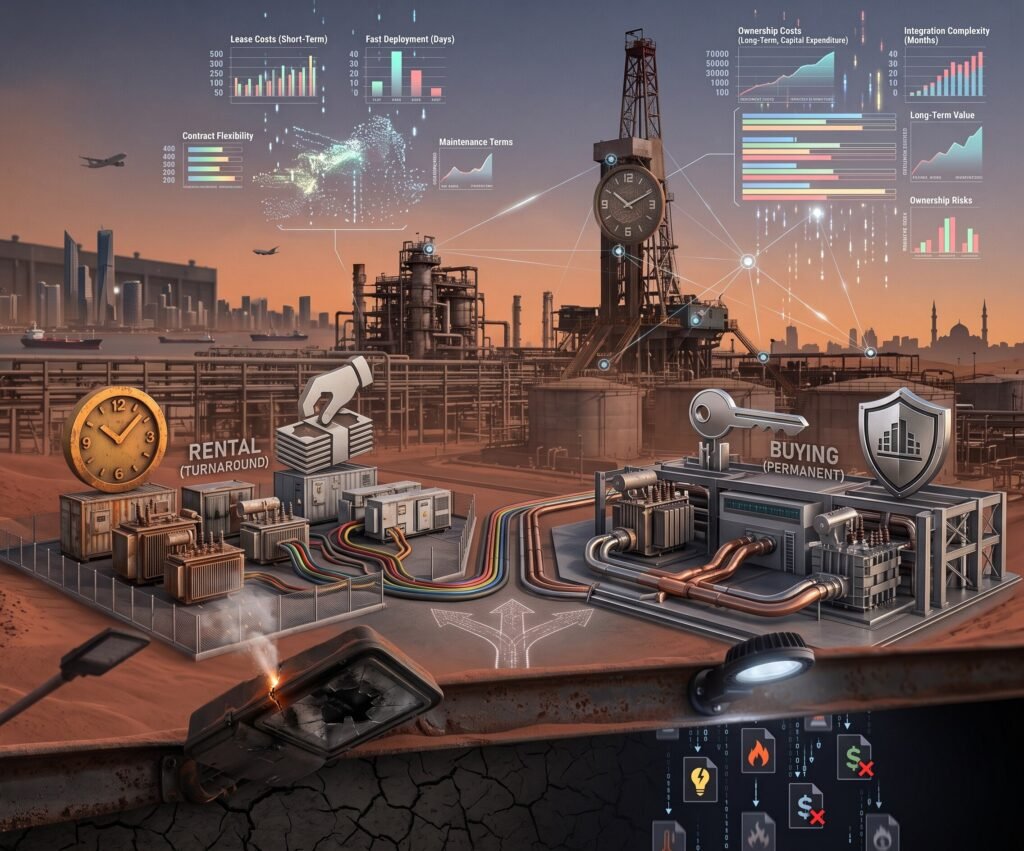
When you’re running a critical industrial operation in the UAE, equipment downtime isn’t just an inconvenience. it’s a financial hemorrhage. If your plant faces an unexpected turnaround or emergency shutdown, sourcing the right explosion-proof transformer becomes a race against time and budget constraints. The question that keeps plant managers up at night isn’t just “where do I get an Ex-proof transformer?” but rather “should I rent or buy one?”
This isn’t a simple yes-or-no question. The answer depends on your specific operational context, financial position, regulatory environment, and long-term asset strategy. After working with dozens of industrial facilities across the UAE, we’ve seen this decision made and regretted far too many times. This guide walks you through the framework that successful facility managers use to make this critical choice.
Understanding Ex-Proof Transformers: Why They Matter in UAE Operations
Before diving into the rent-versus-buy decision, let’s establish why explosion-proof transformers are non-negotiable in certain UAE industrial environments.
An explosion-proof transformer (also called Ex-proof or ATEX-certified transformer) is specifically engineered for deployment in hazardous locations where explosive atmospheres might exist. These include:
- Oil and gas facilities
- Chemical processing plants
- Pharmaceutical manufacturing units
- Mining operations
- Port facilities handling flammable cargo
- Refineries and petrochemical complexes
The UAE’s energy sector particularly the oil and gas industry makes explosion-proof equipment compliance mandatory, not optional. The Dubai Municipality and Abu Dhabi regulatory authorities enforce ATEX (European standardization for equipment used in explosive atmospheres) and IECEx certifications strictly. Non-compliance doesn’t just invite penalties; it creates operational shutdown scenarios that can cost thousands of dirhams per day.
A low-voltage portable Ex-proof transformer isn’t a commodity purchase. It’s a specialized piece of safety infrastructure that bridges your hazardous zone operations with standard electrical supply, ensuring your facility operates within legal and safety parameters.
The Rent vs. Buy Decision Framework: A Practical Analysis
Phase 1: Assessing Your Operational Timeline
The first variable in your decision matrix is duration. This is where most facility managers make their initial assessment.
Short-term Emergency (Days to Weeks): If your plant turnaround or emergency repair will last 2-6 weeks, renting is typically the clear winner. Here’s why:
During an emergency shutdown, your priority is operational speed, not asset ownership. When a transformer fails unexpectedly, you need a replacement within 48-72 hours, not weeks. Rental companies maintain inventory specifically for these scenarios. Getting equipment certified, transported, and installed from a rental provider takes 2-3 days in the UAE. Purchasing and installing new equipment takes 4-8 weeks minimum.
The math is straightforward: Emergency equipment rental in the UAE typically costs AED 15,000-25,000 per month for a low-voltage Ex-proof transformer. A 4-week emergency shutdown means approximately AED 15,000-20,000 in rental costs. Compare this to the daily operational losses when your plant sits idle often exceeding AED 100,000-500,000 per day depending on your industry. The rental cost becomes negligible against the losses from extended downtime.
Medium-term Turnaround (2-6 Months): This is where the decision becomes genuinely complex. At this duration, both options become financially viable.
Rental costs compound significantly over 6 months. A transformer rented for 24 weeks at AED 20,000/month costs approximately AED 120,000-150,000. Meanwhile, purchasing a new low-voltage portable Ex-proof transformer from reputable manufacturers ranges between AED 80,000-200,000, depending on specifications and kVA rating.
However and this is critical you must factor in acquisition time, installation costs (AED 5,000-10,000), commissioning (AED 3,000-5,000), and ongoing maintenance contracts (AED 8,000-12,000 annually).
At this duration, smart facility managers often negotiate a “rent-to-own” arrangement with suppliers. This structure provides rental flexibility while building equity toward ownership. In the UAE market, several vendors offer this arrangement, allowing you to pivot if your project timeline extends or contracts.
Long-term Asset Strategy (12+ Months): When your facility needs permanent or semi-permanent additional capacity, ownership becomes financially inevitable.
Let’s use real numbers: A facility planning a permanent second production line or expansion needs consistent transformer capacity. Renting that capacity for 36 months (AED 20,000 × 36) costs AED 720,000. Purchasing the same transformer for AED 150,000, with a 10-year operational life and maintenance costs of AED 10,000 annually, totals approximately AED 250,000 over the same period.
Ownership wins decisively once you cross the 12-month threshold.
Phase 2: Capital and Cash Flow Analysis
Equipment procurement decisions aren’t made in operational isolation they’re made within your facility’s financial reality.
Capital Availability: If your facility has capital budget already allocated for equipment procurement, the calculus shifts toward buying. Capital expenditure (CapEx) is often budgeted separately from operational expenditure (OpEx), with different approval processes and funding sources. Some facilities have CapEx budgets sitting unused because projects haven’t materialized; emergency transformer needs can actually optimize existing allocations.
Cash Flow Constraints: Conversely, if your facility is managing tight working capital common among mid-tier manufacturing operations in the UAE during economic cycles rental preserves cash and maintains flexibility. Rental costs flow through Op Ex budgets, which are often easier to justify to finance teams during emergencies.
Tax and Depreciation Implications: This is where your CFO becomes your strategic partner. In the UAE, different equipment ownership structures have different tax treatments:
- Owned equipment: Subject to depreciation schedules under UAE Corporate Tax regulations (though some assets qualify for special deductions)
- Rented equipment: Fully deductible as operational expense in the year incurred
- Finance lease arrangements: Complex hybrid structures requiring accounting treatment considerations
Consulting your facility’s finance team on the specific tax implications based on your organizational structure isn’t overcautious. it’s essential. A transformer that makes operational sense might create accounting complications, or vice versa.
Phase 3: Technical Specifications and Standardization
This consideration often gets overlooked in rent-versus-buy discussions, but it’s where technical decisions merge with strategic ones.
Your Existing Infrastructure: Does your facility already operate Ex-proof transformers? What are their specifications KVA rating, voltage transformations, protection classifications? If your facility standardizes on specific manufacturers or models, this has downstream implications.
Renting forces you to accept whatever equipment rental companies have available. This might mean temporary incompatibilities with your existing monitoring systems, protection schemes, or grounding standards. These incompatibilities aren’t just inconveniences, they create safety supervision challenges. Your maintenance teams must operate equipment that doesn’t match documented procedures, increasing error risk.
Purchasing equipment that matches your standardization specifications eliminates this problem permanently. Over a 10-year operational lifespan, standardized equipment also reduces training costs and spare parts complexity.
Regulatory Compliance and ATEX Certification: This is where the UAE context matters critically.
All Ex-proof transformers in hazardous locations must carry valid ATEX, IECEx, or equivalent certification. Rental companies maintain this certification, but you should independently verify:
- Certification validity dates (certificates expire)
- Whether the equipment revision matches current regulatory requirements
- Whether the supplier updates equipment to meet evolving standards (this happens more frequently than many realize)
When you purchase equipment, you inherit the responsibility for maintaining compliance documentation throughout the operational lifespan. This isn’t burdensome with reputable manufacturers, but it’s worth understanding.
Regional Considerations: The UAE Advantage and Constraint Reality
The UAE industrial equipment market presents unique characteristics that influence this decision.
Inventory Availability: Unlike Europe or North America with established equipment rental marketplaces, the UAE market is tighter. Specialized Ex-proof transformers not generic transformers, but certified explosion-proof units aren’t sitting on every rental company’s shelf. The main suppliers operate from Dubai and Abu Dhabi, which generally covers the emirate adequately, but specialized sizes or ratings might require 5-7 day sourcing.
This availability constraint actually shifts the calculation: maintaining owned backup equipment provides operational insurance that rental alone cannot guarantee.
Import Lead Times: If you’re considering purchasing, factor in realistic import timelines:
- Standard equipment: 4-6 weeks from order to port receipt
- Expedited shipping: 3-4 weeks at premium freight costs (add 15-20% to equipment price)
- Customs clearance in UAE: 3-5 business days
Labor Cost Structures: Installation and commissioning labor in the UAE costs significantly more than in developing markets. An expatriate technician runs AED 500-800 per day in the UAE market. Rental companies often bundle installation and initial commissioning; purchased equipment requires hiring or contracting this expertise separately.
Maintenance Ecosystem: The UAE has developed a robust industrial maintenance ecosystem, particularly in Dubai and Abu Dhabi. However, if your facility operates in remote locations (interior Emirates or southern regions), maintenance response times extend significantly. Owned equipment allows you to maintain spare components and parts inventory; rented equipment depends on the rental company’s service response commitments.
Financial Modeling: When to Rent, When to Buy
Let’s establish clear financial thresholds using realistic UAE market pricing:
Scenario A: Emergency 4-Week Turnaround
- Rental cost: AED 20,000 (4 weeks × AED 5,000/week)
- Alternative (emergency purchase + rush shipping): AED 150,000 purchase price + AED 30,000 expedited shipping + AED 8,000 installation = AED 188,000
- Decision: Rent clearly wins (saves AED 168,000)
Scenario B: 4-Month Manufacturing Ramp-Up
- Rental cost: AED 80,000 (4 months × AED 20,000/month)
- Purchase alternative: AED 150,000 + AED 8,000 installation + AED 3,000 commissioning = AED 161,000
- First-year maintenance: AED 10,000
- Decision: Rent has lower immediate cost, but approaches purchase economics (difference narrows to AED 81,000)
- Strategic consideration: If ramp-up might extend to 6 months, purchase becomes competitive
Scenario C: Permanent Capacity Addition (36-month horizon)
- Rental cost: AED 720,000 (36 months × AED 20,000/month)
- Purchase alternative: AED 150,000 + AED 11,000 (installation/commissioning) + AED 30,000 (3 years maintenance) = AED 191,000
- Residual value after 36 months: AED 80,000 (50% depreciation)
- Net purchase cost: AED 111,000
- Decision: Buy decisively wins (saves AED 609,000 over 36 months)
These scenarios establish the critical threshold: If your requirement exceeds 8-10 months, purchasing becomes financially superior to renting.
Hidden Costs That Derail Procurement Decisions
Smart facility managers account for costs that don’t appear in initial quotes.
Rental Hidden Costs:
- Transportation and delivery fees (if not included): AED 2,000-4,000 per trip
- Demobilization costs when returning equipment
- Damage assessment fees (rental companies charge for any wear beyond normal operation)
- Extended rental penalties if you exceed agreed duration
- Insurance if damage occurs during your operations (liability clarification matters)
Purchase Hidden Costs:
- ATEX/compliance documentation and certification transfers: AED 2,000-3,000
- Decommissioning and disposal costs if equipment reaches end-of-life: AED 5,000-8,000
- Extended warranty or maintenance contracts beyond Year 1: AED 10,000-15,000 over equipment lifespan
- Spare components inventory to ensure operational reliability: AED 8,000-12,000
Understanding these costs prevents budget surprises that flip a “good decision” into a regrettable one.
The Regulatory and Compliance Dimension
This deserves separate emphasis because compliance failures create cascading problems.
ATEX Certification and Your Responsibility: When you rent equipment, the rental company maintains responsibility for certification validity. When you purchase, you become the certificate custodian. The Dubai Municipality and Abu Dhabi regulatory authorities don’t care that you hired someone to maintain the equipment the responsibility flows to the asset owner.
This means:
- Regular inspection intervals must be documented
- Certification renewals must be tracked and scheduled
- Modifications to the equipment require re-certification
- Inspection records must be maintained for audit purposes
For many facilities, this administrative overhead provides a reason to rent. For others particularly those with robust maintenance documentation systems ownership actually simplifies compliance because the facility controls the equipment’s operational environment entirely.
Environmental and Disposal Considerations: Ex-proof transformers typically contain mineral oil as insulation medium. When equipment reaches end-of-life, proper disposal and environmental compliance are mandatory. Rental companies handle this with their inventory; purchased equipment remains your environmental responsibility.
The cost implication: proper disposal runs AED 5,000-8,000. More significantly, if your facility is environmentally conscious or planning ESG certifications, equipment recycling and proper disposal become strategic, not just compliance items.
Storage and Space Constraints in UAE Operations
One practical consideration specific to UAE industrial zones: land and storage space command premium value.
If your facility operates in Dubai’s Jebel Ali Industrial Area or Abu Dhabi’s Industrial Zone, backup equipment storage competes with production space. Rental equipment isn’t stored on your premises; it arrives when needed and departs when no longer required. For facilities managing constrained square footage, this operational simplicity justifies rental even at higher per-month costs.
Conversely, facilities with adequate spare equipment storage areas can justify ownership purely on the basis of rapid deployment capability. You maintain operational insurance without depending on external suppliers.
Negotiation Strategies: Maximizing Value Regardless of Your Choice
Whether you choose to rent or buy, negotiation is where many facility managers leave money on the table.
For Rental Decisions:
- Negotiate long-term discounts if your requirement extends beyond 3 months. Rental companies offer 10-15% reductions for 6+ month commitments
- Bundle services: negotiate installation, commissioning, and maintenance into the rental rate rather than paying à la carte
- Secure defined service level agreements (SLAs) with specific response times for maintenance issues
- Negotiate fixed pricing over the rental period to avoid rate increases mid-project
- Clarify damage liability boundaries small wear items vs. catastrophic failure should have different cost treatments
For Purchase Decisions:
- Negotiate extended warranty programs. First-year failure coverage is typically included; extending to 3-5 years adds substantial value at modest cost
- Request manufacturer training for your maintenance team. Good equipment suppliers include this; it reduces your operational errors and ensures equipment longevity
- Negotiate supply agreements for spare components. Locking in spare parts pricing for 5-10 years protects against future cost escalation
- Explore financing options that may improve your cash flow compared to outright purchase, particularly if your facility has favorable credit terms with suppliers
- Request references from other UAE facilities using the same equipment. This groundtruthing catches reliability issues before they become your problems
Decision Checklist: Your Strategic Framework
Use this checklist to systematize your rent-versus-buy decision:
Timeline Clarity:
- □ Is the equipment need temporary (weeks-months) or permanent (years)?
- □ Have you built realistic contingency into project timelines, or is every day critical?
- □ Could the requirement extend beyond current planning, and what’s the cost of extending rental vs. transitioning to ownership?
Financial Reality:
- □ Is your facility operating with capital budget constraints or cash flow limitations?
- □ What are the specific tax implications in your organizational structure?
- □ Have you identified all hidden costs (transportation, insurance, decommissioning)?
Operational Context:
- □ Do you have existing standardization requirements that constrain rental compatibility?
- □ What’s your facility’s equipment maintenance capability? Can you effectively manage owned assets?
- □ How critical is rapid deployment capability for your operations?
Regulatory and Compliance:
- □ Are you comfortable assuming long-term ATEX certification responsibility?
- □ How stringent are your environmental and ESG reporting requirements?
- □ Does your regulatory environment favor owned vs. rented assets?
Market and Supplier Reality:
- □ Have you contacted at least two reputable rental and two equipment suppliers?
- □ What are realistic lead times for both rental availability and equipment purchase?
- □ Can you secure service level agreements that match your operational requirements?
Real-World Case Studies: UAE Facility Decisions
Case Study 1: Rapid Expansion Decision A pharmaceutical manufacturing facility in Dubai’s Industrial Park faced unexpectedly strong demand. Their manufacturing timeline could be extended by 6 months if they added production capacity. Initial analysis: “We need temporary transformer capacity rent it.”
Three months into the rental period, market conditions strengthened. Extending the production line became permanent strategy. The facility renegotiated their rented transformer into a purchase arrangement, building equity into the ownership. This flexibility made renting the optimal initial choice, even though ownership ultimately proved necessary.
Key Learning: When your operational environment is uncertain, rent initially. Build exit options into your rental agreements that allow seamless transition to ownership if circumstances change.
Case Study 2: Standardization Strategy A petrochemical facility operating multiple production lines chose to purchase Ex-proof transformers that matched their standardized electrical architecture. Initial equipment cost was higher than rental alternatives, but over 8 years, the standardization reduced:
- Maintenance training requirements (single standard vs. multiple equipment types)
- Spare parts complexity (inventory management became significantly simpler)
- Downtime incidents (teams operated familiar equipment with documented procedures)
The facility calculated that standardization-driven operational efficiency reduced total cost of ownership by approximately 18%, making equipment ownership financially superior despite higher initial capital investment.
Key Learning: If your facility operates multiple interconnected systems, standardization can justify ownership even when individual equipment might suggest rental.
Case Study 3: The Remote Location Challenge A facility operating in the southern UAE region (outside primary industrial areas) discovered that equipment rental companies offered limited service response. A 1-day maintenance issue with rental equipment extended to 3-4 days because of transport logistics. The facility switched to owned equipment, maintained spare components locally, and reduced MTTR (Mean Time to Repair) from 72+ hours to 4-6 hours. While ownership increased capital requirements, operational reliability improvement generated ROI within 18 months.
Key Learning: Geographic isolation strengthens the case for equipment ownership. Remote operations that depend on rapid repair capability often make ownership the only viable strategy.
The Hybrid Approach: Rent-to-Own and Flexible Agreements
An increasingly popular middle path in the UAE equipment market is structured rental agreements that transition to ownership.
Rent-to-Own Mechanics:
- Months 1-6: Rental period at defined monthly rate (typically AED 18,000-22,000 for low-voltage Ex-proof transformers)
- Months 7-12: Transition period where 40-50% of monthly payments are credited toward equipment purchase
- Month 13 onward: Equipment ownership transfers, with remaining balance payable or financed
This structure provides:
- Operational flexibility (you can still exit if circumstances change during initial rental)
- Financial optimization (eventual ownership builds equity from Month 7)
- Risk mitigation (equipment is proven reliable before you commit to ownership)
Reputable suppliers in the UAE market increasingly offer this structure because it converts short-term rentals into long-term customer relationships. When evaluating rental options, specifically ask whether your supplier offers rent-to-own arrangements.
Maintenance and Lifecycle Considerations Beyond Procurement
Your procurement decision shouldn’t exist in isolation from operational maintenance strategy.
Preventive Maintenance Under Rental: Rental agreements typically specify maintenance responsibility allocation. Understanding this matters:
- Does the rental company handle all preventive maintenance, or do you share responsibility?
- Are there minimum hours-per-year maintenance requirements in the rental agreement?
- What happens to rental costs if maintenance is inadequate and equipment performance degrades?
Clarifying maintenance responsibility prevents situations where equipment deteriorates during rental, and you’re unable to determine responsibility for deterioration.
Preventive Maintenance Under Ownership: Owned equipment requires defined maintenance schedules:
- Weekly visual inspections (oil level, connections, temperature indicators)
- Monthly electrical testing and load verification
- Quarterly thermography and thermal imaging to detect developing issues
- Annual third-party certification and ATEX compliance verification
Budget AED 8,000-15,000 annually for this maintenance protocol. Many facility managers underestimate maintenance costs, then discover mid-life that deferred maintenance creates unexpected failures. Budgeting realistic maintenance conserves equipment lifespan and maintains safety certification validity.
Common Mistakes That Facility Managers Make (And How to Avoid Them)
Mistake 1: Assuming Rental is Always Cheaper Reality: For durations exceeding 8-10 months, rental becomes expensive. Many facilities that initially rent “temporarily” end up converting to purchase because rental rates cumulate to ownership costs by Month 9-10. Fix: Model both scenarios honestly beyond your current timeline. Build 20-30% contingency into project durations to test whether initial rental decisions remain optimal if timelines extend.
Mistake 2: Ignoring Compatibility and Standardization Reality: Rental equipment that doesn’t match your electrical architecture creates integration complexity, safety risks, and increased maintenance burden. Fix: Never rent equipment without verifying compatibility with your existing infrastructure. Require suppliers to confirm that rental equipment meets your standardization specifications.
Mistake 3: Underestimating Hidden Costs Reality: Equipment procurement costs extend far beyond the base equipment price. Transportation, installation, testing, commissioning, and compliance documentation add 20-35% to acquisition costs. Fix: When comparing rental vs. purchase, build a comprehensive cost model that includes all ancillary costs. Request detailed quotes that itemize each cost component.
Mistake 4: Assuming Rental Minimizes Your Compliance Responsibility Reality: Even with rental equipment, your facility maintains responsibility for safe operation and regulatory compliance during the rental period. Fix: When renting, get written confirmation from the rental company regarding ATEX certification currency, inspection schedules, and your liability boundaries. Don’t assume responsibility automatically transfers to the rental company.
Mistake 5: Neglecting Service Level Agreements Reality: Equipment failure during critical production periods creates operational crises. Without defined SLAs, rental companies offer no guarantees for repair response times or replacement equipment. Fix: For any rental exceeding 4 weeks, negotiate explicit SLAs with defined response times (e.g., “4-hour emergency response” or “24-hour equipment replacement”). Get financial penalties in the agreement if the rental company fails to meet these commitments.
Looking Forward: Equipment Trends and Technology Considerations
The Ex-proof transformer market is evolving. Understanding trends helps you make procurement decisions that remain optimal beyond current operational cycles.
IoT-Enabled Monitoring: Modern Ex-proof transformers increasingly integrate temperature sensors, load monitoring, and condition-based diagnostics. This functionality extends equipment lifespan by enabling predictive maintenance rather than reactive repair. If your facility is upgrading to predictive maintenance protocols, newer equipment justifies premium pricing because it enables this transition.
Environmental Compliance: Regulation around mineral oil in electrical equipment is strengthening globally. While UAE currently permits standard mineral oil insulation, European and North American trends toward bio-based or synthetic insulation materials suggest this may change. Purchasing equipment today should consider whether it can accommodate future insulation upgrades or whether you’re committing to legacy technology.
Energy Efficiency Standards: Similarly, transformer efficiency standards are tightening. Modern equipment achieves 1-2% efficiency improvements over 10-year-old models. Over the equipment lifespan, this translates to measurable energy savings. If your facility operates under energy cost optimization pressures, this efficiency improvement justifies premium pricing for newer equipment.
Conclusion: The Decision Is Contextual, Not Universal
After examining renting versus buying Ex-proof transformers from every angle, one truth emerges: there is no universal answer. The optimal decision depends on your specific operational context, financial structure, and strategic direction.
Rent if:
- Your equipment need is genuinely short-term (weeks to 3 months)
- Your facility faces cash flow constraints and needs to preserve capital
- Equipment compatibility with your existing infrastructure is questionable
- Your operational location makes maintenance access unpredictable
- Your regulatory environment or compliance documentation systems are developing
Buy if:
- Your equipment need extends beyond 8-10 months
- Your facility has standardization requirements that rented equipment cannot match
- You operate in locations where equipment availability is limited
- Your facility can support the administrative and maintenance responsibilities
- Capital budget exists and tax treatment favors ownership
Consider Hybrid Approaches (Rent-to-Own) if:
- Your timeline is uncertain (could be short-term or extend to permanent)
- You want to pilot equipment before committing to full ownership
- You prefer financial flexibility without sacrificing ownership optionality
The framework you’ve reviewed assessing timeline, modeling financials, understanding technical requirements, evaluating regulatory responsibilities, and recognizing regional constraints transforms this decision from a guess into a strategic calculation.
Work with your facility’s finance team, operations managers, and compliance leadership. Run multiple scenarios. Get concrete quotes from reputable suppliers. Build contingency into your timelines. And remember: the “best” decision isn’t the cheapest upfront cost it’s the choice that optimizes your facility’s operational capability, financial sustainability, and strategic direction over the equipment’s actual lifespan.
Frequently Asked Questions About Ex-Proof Transformer Renting and Buying
Q1: How quickly can I rent an Ex-proof transformer in the UAE if I need it urgently?
A: Reputable rental companies in Dubai and Abu Dhabi typically maintain inventory of low-voltage Ex-proof transformers and can deliver within 48-72 hours for emergency situations. However, specialized sizes, specific kVA ratings, or unusual voltage transformations might require 5-7 days. This is why maintaining relationships with 2-3 reliable rental suppliers matters, it gives you backup options if your primary supplier’s inventory is committed. During peak periods (industrial downtime seasons in Q2-Q3), availability tightens further, so advance planning is advisable even for “emergency” scenarios.
Q2: What’s the typical cost range for purchasing a low-voltage portable Ex-proof transformer in the UAE?
A: Pricing depends heavily on specifications. A standard 100-500 kVA low-voltage Ex-proof transformer typically ranges AED 80,000-150,000 for equipment from established manufacturers with valid ATEX/IECEx certifications. Premium brands or highly specialized configurations might reach AED 200,000+. Rental costs typically run AED 15,000-25,000 per month, depending on specifications and service inclusions. This is why the 8-10 month crossover point where rental and purchase costs approximate each other is realistic anything beyond this period financially favors ownership.
Q3: Who maintains responsibility for ATEX certification when I rent equipment?
A: Responsibility allocation depends on your rental agreement. Generally, the rental company maintains certification currency and inspection validity, but your facility remains responsible for ensuring the rental equipment is safe for your specific hazardous location classification and isn’t misused in ways that void certification. This is a critical distinction: the rental company certifies the equipment; you certify its appropriate use within your facility’s environment. Always get written clarification in your rental agreement about this responsibility allocation.
Q4: Can I rent Ex-proof transformers and transition to purchase if my project extends?
A: Yes, and this is increasingly common. Rent-to-own arrangements allow you to rent initially, then convert to ownership if timelines extend. Typically, 40-60% of rental payments made beyond month 6-8 apply as credit toward equipment purchase. This structure gives you operational flexibility without forcing an ownership commitment upfront. When requesting rental quotes, specifically ask whether the supplier offers rent-to-own options.
Q5: What happens to a rented transformer if it fails or gets damaged during my project?
A: This is governed by your rental agreement. Generally, normal wear-and-tear is the rental company’s responsibility, but damage resulting from misuse, improper maintenance, or your operational errors is charged to you. This is why getting specific damage liability definitions in writing matters enormously. Request clarity on:
- What constitutes “normal wear” (some companies define this very narrowly)
- Whether you’re responsible for minor repairs vs. major failures
- What insurance applies and whether you need supplementary coverage
- What happens if equipment fails due to environmental factors beyond your control
Q6: How do I verify that rental or purchased equipment actually has valid ATEX certification?
A: Always request to see the equipment’s ATEX certificate (not just the supplier’s word). The certificate should:
- Display the equipment’s specific classification (e.g., Ex d, Ex e, Ex p)
- Show hazardous group and category (e.g., Group II Category 3)
- Include current certification validity dates
- Reference the specific equipment model and serial number
Check the NANDO (New Approach Notified and Designated Organisations) database online at https://nando.ec.europa.eu/ to verify whether the certification body itself is legitimate. Counterfeit or expired certifications create serious compliance violations, so this verification step isn’t paranoia it’s mandatory diligence.
Q7: If I buy an Ex-proof transformer, what’s my ongoing compliance burden?
A: Owned equipment requires:
- Annual inspections and certifications: AED 3,000-5,000 per year
- Maintenance documentation: Detailed logs of all inspections, repairs, and modifications
- Re-certification if modifications occur: Any changes to the transformer require re-testing and certification (AED 2,000-4,000)
- Disposal planning: When equipment reaches end-of-life, proper environmental disposal is your responsibility (AED 5,000-8,000)
This ongoing compliance responsibility is why some facilities prefer rental it transfers administrative burden to the rental company. Others prefer ownership because they control the equipment’s operational environment entirely.
Q8: What’s the realistic lifespan of an Ex-proof transformer, and how does that affect purchase decisions?
A: A properly maintained low-voltage Ex-proof transformer operates reliably for 15-20 years. However, ATEX regulations require periodic re-certification, and insulation degradation accelerates in hot climates (relevant for UAE operations). Plan conservatively for 10-15 years of reliable operation when making purchase decisions. This lifespan calculation affects your financial modeling equipment purchased today should deliver value over this 10-15 year period.
Q9: Are there financing options available for Ex-proof transformer purchases in the UAE?
A: Yes. Major equipment suppliers and some commercial banks offer equipment financing (typically 3-5 year terms). Finance agreements can sometimes be more attractive than outright purchase if:
- Your facility has capital constraints
- Tax treatment favors finance lease vs. ownership
- You want to preserve cash for other operational priorities
Discuss financing options with your supplier and finance team. Some rent-to-own arrangements are structured as disguised financing anyway, so comparing these options becomes important.
Q10: How do I compare rental companies’ reliability and service quality when requesting quotes?
A: Don’t rely solely on price. Request references from other UAE facilities using their equipment, and actually call those references. Ask about:
- Average response time for equipment failures or maintenance requests
- Equipment downtime incidents and how they were resolved
- Whether the rental company maintained equipment certifications reliably
- Whether additional fees or hidden charges appeared during the rental period
Price is only one variable in procurement. Service reliability matters equally because equipment failure during your critical production creates costs far exceeding rental rate differences.
Q11: Can I import an Ex-proof transformer from outside the UAE to avoid local pricing?
A: Technically yes, but practically it creates complications. Imported equipment must be:
- ATEX or IECEx certified (which adds compliance verification costs)
- Cleared through UAE customs (3-5 business day process)
- Re-tested and certified for UAE operations if not coming with active certifications
- Potentially adjusted for local electrical standards and grounding requirements
Import costs (freight, customs, inspection, modification) typically add 25-35% to equipment cost, eliminating any price advantage over local suppliers. Additionally, most reputable local suppliers already source from international manufacturers anyway. You’re usually paying premium pricing to avoid local relationships, which doesn’t create financial value.
Q12: What should I include in my equipment evaluation criteria to ensure I’m making the best rent-vs-buy decision?
A: Create a comprehensive decision matrix that scores:
- Timeline certainty (0-10 scale): How confident are you in your timeline?)
- Financial impact (0-10 scale): Model both scenarios honestly
- Operational compatibility (0-10 scale): Does rental equipment match your infrastructure?)
- Maintenance capability (0-10 scale): Can your team effectively manage owned equipment?)
- Compliance complexity (0-10 scale): Are you comfortable with certification responsibility?)
- Service criticality (0-10 scale): How critical is rapid repair response to your operations?)
Weight these criteria based on your facility’s specific priorities. This systematic approach prevents emotional or intuitive decisions that don’t align with your actual operational needs.
Final Strategic Recommendations for UAE Industrial Facilities
For Emergency/Temporary Needs (1-3 months): Rent immediately. Don’t overthink this scenario. The operational cost of downtime vastly exceeds rental costs. Establish relationships with 2-3 reliable rental suppliers and keep their contact information accessible. During emergencies, you won’t have time to evaluate and compare; you need to act.
For Medium-Duration Projects (3-8 months): Get firm quotes for both rental and purchase. Build a comprehensive financial model that includes all hidden costs. Consider rent-to-own arrangements that provide flexibility. Engage your finance and operations teams in this decision because the optimal choice depends on your specific context.
For Permanent Capacity Needs (12+ months): Purchase equipment that matches your facility standardization. Build maintenance capability and compliance documentation systems. This investment in permanent infrastructure pays dividends over the equipment’s 10-15 year operational lifespan.
Always:
- Verify ATEX certifications independently
- Get written clarification on responsibility boundaries (maintenance, liability, compliance)
- Negotiate service level agreements for rapid-response scenarios
- Build contingency into project timelines to test whether decisions remain optimal if circumstances change
- Work with reputable suppliers with proven track records in the UAE market
The Ex-proof transformer procurement decision seems technical on the surface, but it’s fundamentally a strategic business choice about how your facility balances operational needs, financial sustainability, and risk management. The framework and considerations reviewed here transform this decision from guesswork into strategic analysis.
Your facility’s optimal choice depends on your context, not on generic recommendations. Apply this framework, run your numbers, and make decisions with confidence that they’re aligned with your operational and financial reality.
Cactus Global General Trading LLC specializes in industrial electrical equipment for UAE operations, including certified Ex-proof transformers for hazardous locations. Whether your facility requires emergency equipment rental, purchase for permanent capacity, or guidance on rent-versus-buy optimization, our team has the expertise to support your decision-making process.