Walk through almost any industrial facility in Abu Dhabi, Dubai, or Sharjah and you will find at least one area where a maintenance team swapped out an old fixture for a bright new LED light because it was cheaper and easier to source locally. It looks fine. It works fine, for a while. Then someone asks a question during an audit: is this fixture actually rated for the zone it is installed in? Too often, the honest answer is no.
This is one of the most common and most overlooked risks on industrial sites across the UAE. Lighting gets treated as a facilities issue rather than a safety critical decision, and that gap is exactly where accidents, insurance disputes, and failed inspections come from. This article breaks down why ordinary LED fixtures are not suitable for hazardous areas, what actually happens when they are installed anyway, and what a genuinely compliant setup looks like for oil and gas, petrochemical, and industrial sites operating under UAE regulations.
What Actually Makes an Area “Hazardous”
Before talking about lighting failures, it helps to be precise about what a hazardous area actually is, because the term gets used loosely on site.
A hazardous area, sometimes called a classified location, is any space where flammable gases, vapors, or combustible dust can accumulate in quantities sufficient to ignite. This is not limited to obvious spots like a gas processing unit. It also includes tank farms, loading bays, paint booths, fuel storage rooms, and even certain warehouse zones where dust from raw materials builds up.
Globally, two classification systems are used side by side. The zone system, used across the EU and most of the Middle East including the UAE, divides areas into Zone 0, Zone 1, and Zone 2 for gases and vapors, based on how frequently and for how long an explosive atmosphere is present. The class and division system, used mainly in North America, follows a similar logic but with different terminology. The United States Occupational Safety and Health Administration sets out its version of this classification under 29 CFR 1910.307, Hazardous (Classified) Locations, which remains a widely referenced benchmark even outside the US because so much industrial equipment is designed against it.
The key point for facility managers in the UAE is this: classification is not a formality. It determines exactly what kind of electrical equipment, including lighting, is legally and practically permitted in that space. A fixture rated for a low risk office corridor has no business being installed six meters from a hydrocarbon storage tank, no matter how bright or efficient it is.
Why Standard LED Fixtures Are Not Built for These Zones
This is where most of the confusion happens, and it is worth being blunt about it. A standard commercial or even “industrial grade” LED fixture and a genuine hazardous area LED fixture are two completely different categories of product, even if they look similar from across a warehouse floor.
No Explosion Containment Design
A hazardous area light is engineered so that if an internal spark or overheating component does occur, the enclosure contains the ignition and prevents it from reaching the surrounding atmosphere. This usually means a flameproof or increased safety enclosure built to a specific protection type. A standard LED fixture has none of this. Its housing is designed to keep out dust and rain, not to contain an internal explosion.
Missing or Fake Certification
Genuine hazardous area lighting carries recognized third party certification, most commonly ATEX for products destined for European standards or sold under EU based frameworks, IECEx for the international scheme, and UL listing for equipment referencing North American safety standards. The IECEx System, maintained by the International Electrotechnical Commission, exists specifically so that a single certificate can be recognized across multiple countries rather than needing separate approval in every market. A lot of budget fixtures sold locally carry vague labels like “explosion protected” or “safety approved” without any traceable certificate number, test report, or issuing body. That is not certification. That is marketing.
Thermal Management Built for the Wrong Climate
Standard LED drivers are typically rated for moderate ambient temperatures, often around 25 to 35 degrees Celsius maximum continuous operation. Once internal component temperatures climb past their rated limits, LED drivers degrade faster, light output drops, and failure rates climb sharply. This becomes directly relevant once you consider where these fixtures actually get installed in the UAE.
Incorrect Ingress Protection Rating
IP rating tells you how well sealed a fixture is against dust and water. Many hazardous area installations also sit in areas exposed to wash down cleaning, sand, or coastal humidity. A fixture with an IP54 rating simply will not hold up the same way as one built to IP66 or IP67, and moisture ingress into an electrical enclosure in a classified zone is precisely the failure mode that hazardous area design is meant to prevent.
The UAE Climate Factor: Heat, Humidity, and Sand
This is the angle that gets skipped in most generic hazardous area lighting content, and it deserves real attention because it directly affects equipment lifespan in this region specifically.
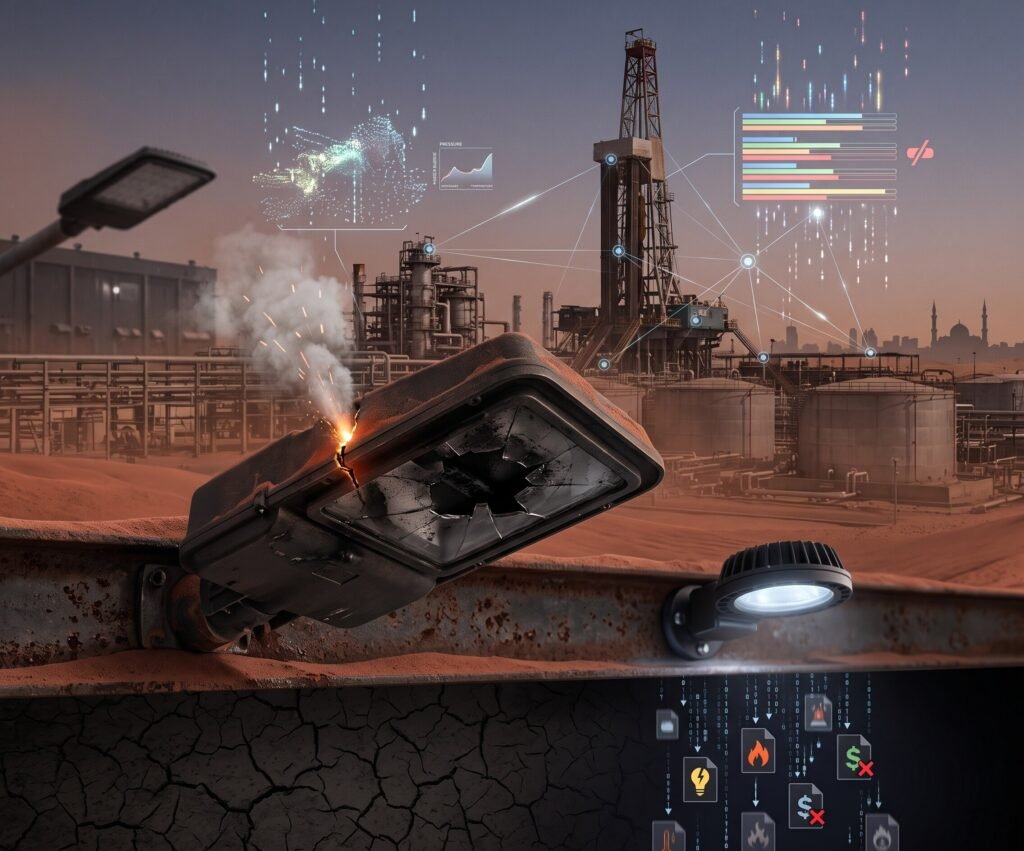
Summer ambient temperatures at ground level on an Abu Dhabi or Dubai industrial site regularly exceed 45 degrees Celsius, and equipment mounted near process pipework, flare stacks, or metal roofing can experience localized temperatures considerably higher than ambient. A fixture that is only tested and rated up to a moderate temperature ceiling is already operating outside its design envelope for a large part of the year before it has even been switched on.
Humidity compounds the problem. Coastal facilities in Abu Dhabi and along the Dubai coastline deal with high relative humidity for much of the year, which accelerates corrosion inside poorly sealed enclosures and increases the risk of condensation forming on internal electronics during temperature swings between day and night.
Then there is sand and fine dust, which is a near constant presence across UAE industrial zones, particularly at inland sites and during shamal wind events. Dust ingress into a poorly sealed fixture does two things at once: it degrades thermal dissipation by coating internal components, and in a classified area it can itself become part of the ignition risk if it settles inside an enclosure that was never designed to keep it out.
Put simply, a fixture designed for a mild European or North American climate and then shipped into a Gulf industrial environment without proper thermal and ingress engineering is set up to underperform from day one, independent of whether it is technically certified for hazardous use.
Real World Failure Scenarios on UAE Sites
It helps to move from theory to what this actually looks like on the ground.
Scenario one: the refinery loading bay. A facility replaces aging sodium vapor lights in a tanker loading area with commercially available LED floodlights purchased for their price and brightness. Within eight months, several units show visible discoloration around the driver compartment and two fail completely during peak summer heat. An internal review finds the fixtures were never rated for the Zone 1 classification of that bay, meaning the facility had been operating out of compliance with its own hazardous area management plan without anyone flagging it at procurement stage.
Scenario two: the fuel storage warehouse. A logistics company storing packaged flammable liquids installs standard LED high bays because the warehouse “does not look like a typical hazardous site.” An insurance assessment during a policy renewal identifies the lighting as non compliant with the facility’s own classified area drawing, creating a gap that the insurer flags as a material risk, directly affecting premium terms.
Scenario three: the gas station canopy. A fuel retailer replaces canopy lighting with a generic LED panel rated for outdoor use but without ATEX or IECEx certification. The fixture performs well for over a year until a driver reports a light flickering intermittently near a fuel dispenser. Inspection finds moisture had entered the housing through a seal that was never designed for the vibration and thermal cycling typical of a forecourt canopy in Gulf conditions.
Scenario four: the manufacturing workshop with combustible dust. A metal fabrication facility assumes hazardous area rules only apply to oil and gas sites, and installs standard LED high bays throughout a workshop that generates fine metal dust during grinding operations. A safety consultant later points out that accumulated combustible dust can create the same ignition conditions as a gas atmosphere under the right circumstances, and that the workshop’s dust collection zones should have been classified and lit accordingly from the outset.
None of these scenarios involve dramatic failure footage. They involve slow, quiet degradation that only becomes visible during an audit, an insurance review, or a near miss, which is exactly why so many facilities carry this risk without realizing it. The pattern across all four is the same: someone made a reasonable sounding decision without checking the classification drawing first, and the gap sat unnoticed for months before anyone connected the dots.
What Compliant Hazardous Area Lighting Actually Looks Like
A properly specified hazardous area light is not simply a bright LED in a tougher looking case. It is a product engineered from the ground up against recognized standards, with documentation to prove it.
At minimum, a compliant fixture for a UAE oil and gas or petrochemical application should carry certification from a recognized notified body, a stated zone and gas group rating that matches the area classification on your facility drawings, a genuine IP66 or higher ingress protection rating, and a thermal design validated for extended operation in high ambient temperatures rather than a mild climate assumption.
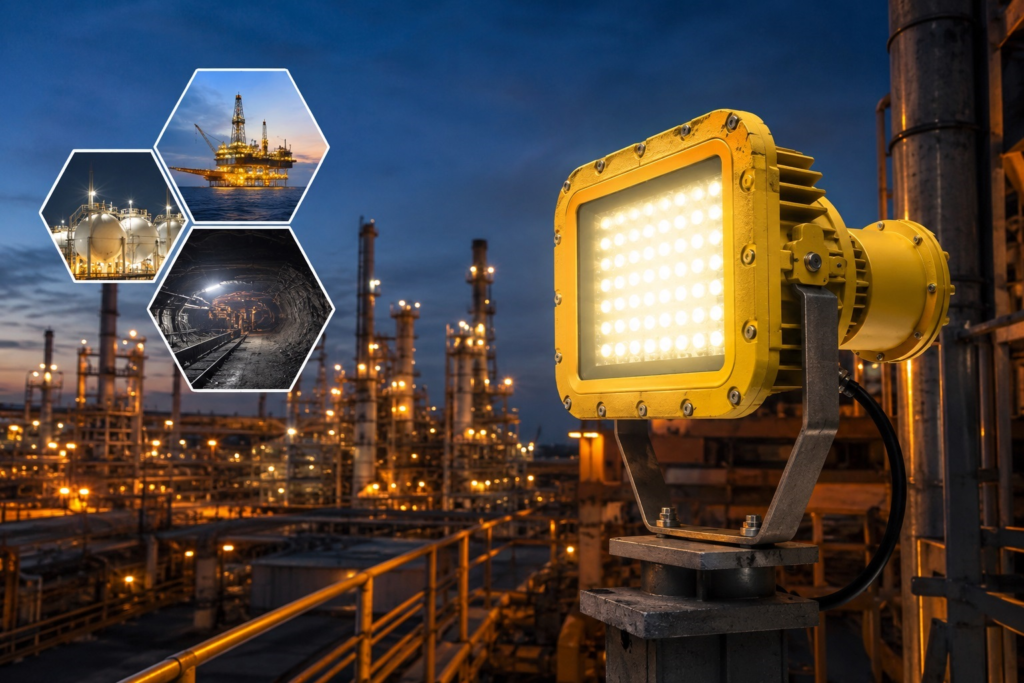
We cover this exact specification gap in more depth in our buyer’s guide to explosion proof flood lights for hazardous areas in Abu Dhabi, which walks through wattage selection and mounting considerations for outdoor industrial areas. If you are currently comparing options for a Zone 1 or Zone 2 installation, our ATEX and UL listed explosion proof LED light range is built specifically around this certification standard, with wattage options from 100W through 240W for oil and gas, petrochemical, and manufacturing environments across Abu Dhabi and the wider UAE.
It is also worth remembering that lighting rarely sits in isolation. The same classified area typically requires junction boxes, sockets, and enclosures that meet equivalent standards, which is why procurement teams reviewing their lighting specification should also revisit adjacent equipment. Our recent piece on why an outdated junction box spec sheet creates hidden compliance risk covers a closely related version of this same problem.
The Regulatory Framework Governing Hazardous Area Lighting in the UAE
UAE facilities do not operate in a regulatory vacuum on this issue, even though enforcement visibility varies by emirate and by sector.
Major operators such as ADNOC apply their own HSE specifications for approved vendors and equipment used across their operated assets, and these specifications generally reference internationally recognized hazardous area standards rather than inventing separate ones. Suppliers holding ADNOC Approved Vendor status, as Cactus GGT does, have already been through a vetting process against these expectations, which is part of why that status matters to procurement teams beyond just being a badge.
At the emirate level, occupational safety frameworks also address electrical work and equipment directly. Sharjah’s occupational safety and health system, for example, publishes a dedicated code of practice for electrical safety at work, setting out minimum requirements that entities operating in the emirate are expected to meet or exceed. Similar civil defence and municipality level requirements apply across Abu Dhabi and Dubai, generally built around the same international certification logic rather than a uniquely local one.
This is a useful point for procurement and HSE teams to internalize: the UAE does not require you to invent compliance from scratch. It requires you to correctly apply globally recognized standards, and to be able to prove that application with documentation if asked.
The Global Certification Standards UAE Facilities Actually Reference
Three certification frameworks come up repeatedly when specifying hazardous area lighting for the UAE market, and understanding the difference matters when you are reading a supplier’s datasheet.
ATEX refers to Directive 2014/34/EU, the European Union framework governing equipment and protective systems intended for use in potentially explosive atmospheres. Although it is an EU directive, ATEX certified equipment is widely specified and trusted across the Middle East because of the rigor of its type examination process.
IECEx is the international scheme mentioned earlier, and it exists precisely to reduce duplicate testing across borders. A single IECEx certificate of conformity, checked against the IECEx online database, gives a facility manager a fast way to verify that a specific product and manufacturer combination has actually been through independent assessment rather than relying on a printed logo alone.
UL listing, meanwhile, is most closely associated with North American markets but is frequently referenced or required by international operators and insurers because of the depth of UL’s testing protocols. A product carrying both ATEX and UL listing, like the VEFL 1017 series lighting we supply, effectively satisfies both European style and North American style expectations at once, which is particularly useful for multinational operators running the same specification across sites in different regions.
How to Audit Your Facility’s Existing Lighting for Hidden Risk
If you manage or advise on a facility with any classified areas, a short internal audit can surface this problem before an external inspector, insurer, or incident does it for you.
Start by pulling your facility’s hazardous area classification drawing, sometimes called an area classification schedule, and confirm it is current. Site changes, new tanks, or process modifications can shift zone boundaries without lighting ever being reassessed against the new drawing.
Next, physically walk each classified zone and record the make, model, and any visible certification marking on every fixture. Photograph nameplates where possible, since certification details are usually stamped or printed directly on the fixture body.
Cross check every fixture against its documented certificate. This means requesting the actual ATEX, IECEx, or UL certificate from the supplier or manufacturer, not just a product brochure, and confirming the zone, gas group, and temperature class match your area classification exactly.
Finally, flag any fixture with no traceable certificate, a certificate that does not match the installed zone, or visible physical degradation such as discoloration, cracked seals, or corrosion around the housing. These are your priority replacements, regardless of how recently they were installed.
Keep a simple register of everything you find, including the fixture location, manufacturer, model, certificate number, and inspection date. This register becomes genuinely valuable the first time an insurer, an ADNOC audit, or a civil defence inspection asks for evidence of your hazardous area equipment status, since producing an organized record on request looks very different from scrambling to compile one after the fact.
Choosing the Right Replacement: A Practical Framework
Once you have identified fixtures that need replacing, the specification process does not need to be complicated, but it does need to be deliberate.
Confirm your exact zone classification first, since this single data point determines almost everything else about the fixture you need. Match wattage to the actual task, since oversizing wastes energy and undersizing creates safety concerns in areas like loading bays or walkways. Verify certification independently rather than trusting a datasheet claim alone, ideally by checking the certificate number against the issuing body’s public database. Consider total cost over the fixture’s expected service life rather than unit price alone, since a properly rated fixture that lasts its full rated lifespan in Gulf conditions is almost always cheaper than replacing a failed budget unit twice within the same period, on top of the compliance exposure it creates in the meantime.
For facilities exploring options across a broader range of explosion proof equipment beyond lighting alone, our Explosion Proof Products category covers the wider range of certified electrical equipment we supply for classified areas across the UAE.
Frequently Asked Questions
What is the difference between explosion proof and standard industrial LED lighting? Explosion proof lighting is designed and certified to contain any internal ignition source so it cannot trigger an explosion in a surrounding flammable atmosphere. Standard industrial LED lighting is built for durability against dust and moisture but has no certified containment design, which makes it unsuitable for classified hazardous areas regardless of how rugged it appears.
How do I know if my facility area is classified as hazardous? Your facility should have a documented hazardous area classification drawing prepared by a qualified engineer, typically as part of the original design or a later HSE review. If this document does not exist or has not been updated after process changes, that itself is a compliance gap worth addressing before selecting any electrical equipment.
Is ATEX certification required in the UAE, or is it optional? ATEX is a European Union directive, so it is not a UAE legal requirement in itself. However, ATEX certified equipment is widely accepted and specified across UAE oil and gas operators because of the rigor of its testing process, and it is frequently required contractually by operators such as ADNOC even where it is not a direct legal mandate.
Can I use a standard LED flood light temporarily in a hazardous area during an emergency repair? This is not advisable. Even short term or temporary use of non certified equipment in a classified zone introduces genuine ignition risk and typically breaches the facility’s own safety management system, regardless of the intended duration.
What wattage of explosion proof LED light do I need for an outdoor industrial area? This depends on the mounting height, the area to be illuminated, and the required lux level for the task performed there. Our ATEX and UL listed range is available from 100W through 240W, and our team can help match wattage to your specific layout when you request a quote.
How often should hazardous area lighting be inspected once installed? Most facilities align lighting inspection with their broader electrical hazardous area inspection schedule, commonly annually at minimum, with additional checks after any process change, extreme weather event, or visible physical damage to a fixture.