
Reviewed by the Cactus GGT product team · Updated November 2026
To get an accurate custom tarpaulin quote, send the finished size, the fabric and weight, how the edges and joins should be made, where every eyelet or fixing goes, any fire or colour requirement, the quantity and the delivery date, ideally on one simple drawing. Quotes go wrong when the supplier has to guess. One firm prices a plain hemmed sheet, another prices welded seams and rope-reinforced edges, and you end up comparing two different products. This guide gives procurement teams, site engineers and HSE officers in the UAE a spec sheet to fill in before asking for prices.
It assumes you already know roughly which material you want and how big the cover needs to be. For measuring a load, use our tarpaulin size guide; for vetting the supplier, see 7 checks for a tarpaulin supplier in Abu Dhabi. This article is about writing the order itself.
Table of Contents
- What makes a custom tarpaulin quote accurate?
- Should you give the finished size or the cut size?
- Which fabric details belong in a custom tarpaulin spec?
- How should hems, seams and corners be made?
- Where should eyelets, D-rings and openings go?
- What should you approve before production starts?
- FAQs about ordering a custom tarpaulin
What makes a custom tarpaulin quote accurate?
A custom tarpaulin quote is accurate when every supplier is pricing the same thing: the same finished dimensions, fabric, edge construction, fixings, tolerances and delivery. That means a written spec with a sketch, not a phone call that says “40 by 20, heavy duty, with eyelets”. The more you define up front, the fewer surprises at delivery.
Use this sheet as a template. Fill in what you know and mark the rest “supplier to advise”, so at least you can see who is proposing what.
| Spec item | What to write | Example |
|---|---|---|
| 1. Use and location | What it covers, indoors or outdoors, exposure to wind and sun | Cover for a pump skid in an open yard, Ruwais |
| 2. Finished size | Length × width after hemming, plus tolerance | 6.0 m × 4.0 m finished, ±2% |
| 3. Fabric | Material, GSM, colour, top coat if PVC | PVC-coated polyester, GSM as quoted, grey |
| 4. Fire requirement | None, or a named test and class | None / supplier to state test report |
| 5. Edges and joins | Hem width, welded or stitched, rope or webbing in hem | Welded hem with rope reinforcement |
| 6. Corners | Corner patches, double layer at stress points | Reinforced patch at all four corners |
| 7. Fixings | Eyelet metal and size, spacing, D-rings or webbing loops | Eyelets every 500 mm, D-rings at corners |
| 8. Openings and extras | Flaps, zips, pockets, cut-outs, labels | Cut-out for exhaust stack with flap |
| 9. Quantity, date, delivery | Number of pieces, required date, site and access | 4 pieces, on site by the 20th, Mussafah |
Nine lines, and every quote you get back can be compared like for like.
Should you give the finished size or the cut size?
Give the finished size: the dimensions you need after the hems, welds and edges are made. The cut size is the raw fabric before hemming and is the supplier’s job to work out. If you only say “6 × 4 m”, one supplier may cut 6 × 4 and hand you a sheet several centimetres smaller once the edges are folded.
Write “finished size” on the drawing and add a tolerance you can live with, for example plus or minus 2% or a fixed figure in centimetres. For a cover that must fit a frame or a truck body, measure the frame itself, not an old tarp, because old sheets stretch and shrink. If the cover drapes over equipment, add the drop down each side and say whether it should reach the ground.

If a standard size will do, it is usually quicker. Our stock PVC tarpaulin sheets come in 18 × 18, 40 × 40 and 60 × 60 ft. A custom tarpaulin makes sense when the shape is irregular, the cover must fit a frame, or you need openings and fixings in exact positions.
Which fabric details belong in a custom tarpaulin spec?
A custom tarpaulin spec should name the material, the fabric weight in GSM, the colour, and any special treatment such as UV stabilisation, top coat or fire retardancy. If you need strength values, ask for tensile and tear figures with the test method, so different fabrics can be compared on the same basis rather than on adjectives.
Some practical notes:
- Material. PVC-coated polyester for waterproof, heavy outdoor covers; canvas tarpaulin where you want the cover to breathe; PE for lighter, shorter-term use. The full comparison is in our materials guide, so we will not repeat it here.
- Weight. State a GSM or ask the supplier to propose one for the duty, and get it on the quote. GSM is the finished fabric weight; it is the number that lets you compare.
- Colour. Some colours are stock and others need a minimum order. Lighter colours stay cooler in sun.
- Fire requirement. If a client or site needs a fire-retardant sheet, write the test and class they expect, such as NFPA 701, EN 13501-1 or DIN 4102-1, and ask for the test report. “FR” on its own is not a spec. If fire rating is not needed, our non-fire-retardant tarpaulin is the economical choice.
How should hems, seams and corners be made?
Specify how edges and joins are made: welded or stitched seams, the hem width, whether a rope or webbing runs inside the hem, and reinforcement patches at corners and fixing points. On PVC fabric, welded seams are normal because they stay waterproof; stitching makes holes. On canvas, stitched seams are standard.
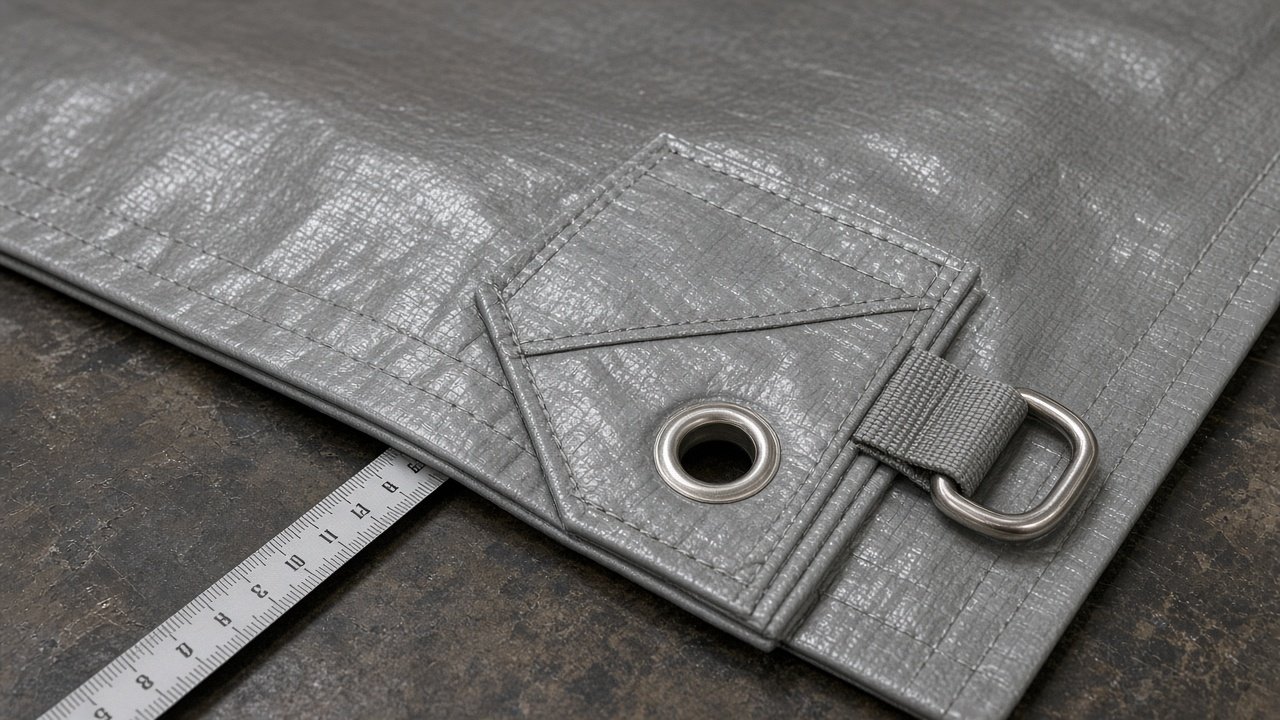
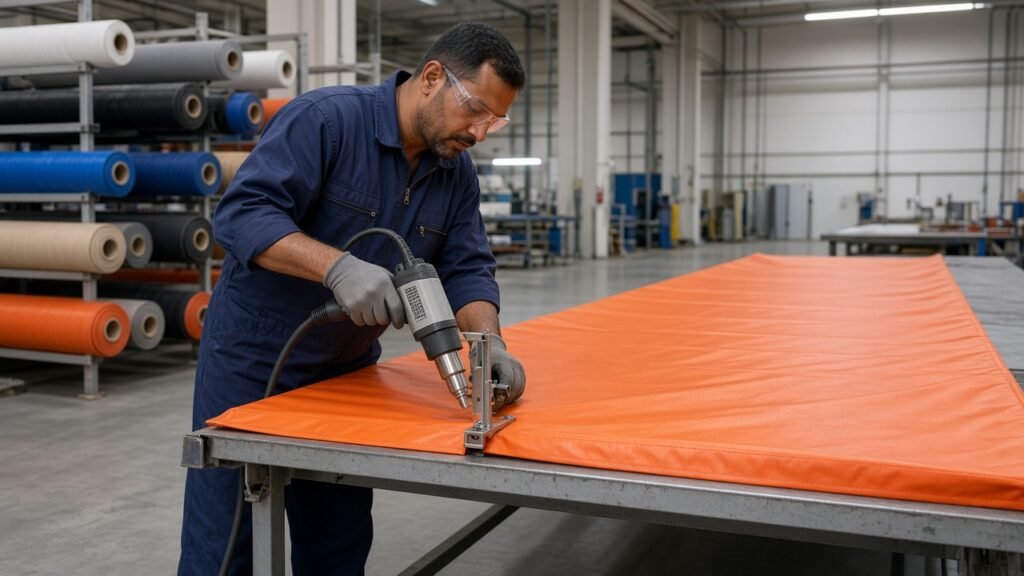
PVC tarpaulin fabric is usually joined by high-frequency (radio-frequency) welding or by hot air or hot wedge, which melt the coating so the two layers fuse. A good weld is as wide as the supplier’s standard for that fabric and shows no dry, unbonded patches. Ask what weld width they use and whether they can send a sample strip you can try to peel apart.
For the edges, a double-folded hem with a rope or webbing inside spreads the pull from each eyelet along the edge instead of into one point. Corners and any spot that will carry a strap or a lifting point should get an extra layer of fabric welded or stitched on. If the cover will be dragged, ask for wear patches where it rubs.
Where should eyelets, D-rings and openings go?
Mark every fixing on the drawing: eyelet spacing along each edge, eyelets at every corner, and the position of D-rings, webbing loops, ties, zips, flaps and cut-outs. Say what metal the eyelets should be. If fixings must line up with hooks on a truck body or a frame, measure those positions and dimension them from one corner.
Points worth deciding up front:
- Spacing. Closer spacing gives more control in wind; wider spacing is cheaper. Match it to the anchor points you actually have.
- Eyelet material and size. Brass, aluminium and stainless steel are common. Near the coast or offshore, ask for stainless or another corrosion-resistant option. Larger eyelets take thicker rope.
- D-rings and webbing loops. Better than eyelets where a strap or hook pulls hard, because the load spreads through the webbing.
- Openings. Cut-outs for pipes, exhaust stacks or lifting lugs need reinforced edges and often a flap so water and sand do not get in.
- Labels. If you run many covers, ask for a welded label or marked ID so each one goes back on the right equipment.
What should you approve before production starts?
Before production, approve a dimensioned drawing and the fabric sample, and ask for a photo of the first piece laid out with a tape measure. For repeat or large orders, approve a pre-production sample. Confirm the lead time, packing and delivery address in writing so the quote, the drawing and the delivery all describe the same custom tarpaulin.
A short approval routine:
- Check the drawing shows finished sizes, tolerance and every fixing.
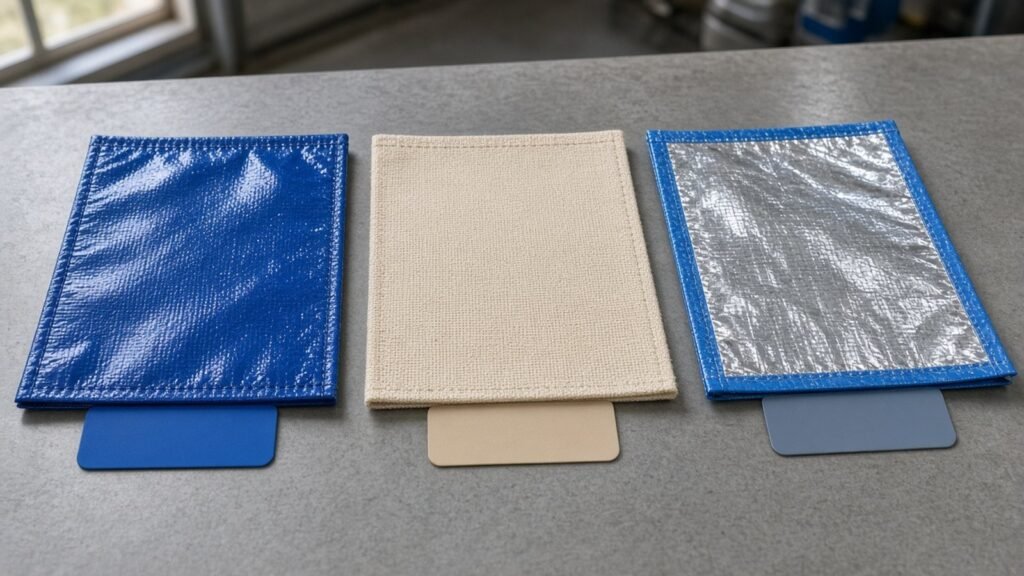
- Approve a fabric swatch in the right colour and weight, with the data sheet.
- For fire-rated orders, check the test report names the same fabric and class you asked for.
- Ask for a photo of the first finished piece with a tape measure along each edge.
- Agree how the cover will be folded, packed and labelled for site.
- On delivery, measure, count eyelets and check welds before signing.
Cactus GGT can quote custom sizes, edges and fixings on our tarpaulin sheets in Abu Dhabi, alongside the stock 18, 40 and 60 ft sheets. Cactus GGT is a registered and approved tarpaulin supplier under the ADNOC vendor system, with Supplier ID: 10076001, which helps where a project needs vendor evidence on file.
FAQs about ordering a custom tarpaulin
What information do I need to order a custom tarpaulin?
Send the finished size and tolerance, the material, weight and colour, any fire requirement with a named test, the edge and seam construction, the position and type of every fixing, openings or flaps, the quantity, delivery date and site. A simple dimensioned sketch saves a lot of back and forth.
What is the difference between cut size and finished size?
Cut size is the raw fabric before hemming. Finished size is the sheet you receive once hems and edges are made. Always order by finished size and state a tolerance, otherwise the delivered cover can be smaller than you expected.
Is a welded or stitched seam better for a PVC tarpaulin?
For PVC-coated fabric, welded seams are normally preferred because the layers fuse and the joint stays waterproof. Stitching puts holes through the coating. Canvas is usually stitched. Ask the supplier for a sample of their seam.
Which eyelets should I specify near the coast?
Choose a corrosion-resistant option such as stainless steel for coastal, marine or offshore use, and size the eyelet for the rope or hook you will use. Brass and aluminium are common on general covers.
How long does a custom tarpaulin take to make?
It depends on the fabric in stock, the size, the number of pieces and the workshop load. Ask for the lead time in writing with the quote. If timing is tight, check whether a stock 18, 40 or 60 ft sheet would do the job.
Ready to price a cover? Send your filled-in spec and a sketch to Cactus GGT and we will come back with options and a lead time. Start from our tarpaulin supplier in Abu Dhabi page, or get a quote directly.