
Reviewed by the Cactus GGT product team · Updated November 2026
To choose tarpaulin sizes that actually cover the job, measure the load, add twice the height plus a tie-down overlap, then round up to the next standard sheet. In the UAE, pick the GSM next, because a correctly sized but very thin sheet will not last long in the sun. This PVC-focused size guide is for site buyers and storekeepers who need a clear measurement method, a size chart in metres, and a simple GSM chart.
A sheet that is too small leaves edges exposed. A sheet that is far too large wastes money and flaps in the wind, which strains the eyelets. We stock PVC tarpaulin sheets in 18 × 18 ft, 40 × 40 ft and 60 × 60 ft. For material choice, use the PVC vs canvas vs polyethylene comparison. This page stays on tarpaulin sizes, measuring and GSM — not on vendor approval or a long list of uses.
Table of Contents
- How do you use this guide to tarpaulin sizes?
- What do tarpaulin sizes mean in feet and metres?
- How do you measure before you pick a size?
- Which standard tarpaulin sizes fit common UAE jobs?
- How does a GSM chart sit alongside tarpaulin sizes?
- How should you overlap, join and fix the sheet?
- FAQs about tarpaulin sizes
How do you use this guide to tarpaulin sizes?
Use this guide in three steps: measure length, width and height; add drop and overlap to get the required tarpaulin sizes; then compare that number with a standard size chart and a GSM chart. Confirm whether the quoted size is in feet or metres, and whether it is the cut size or the finished size after hemming.
The method is the same for a single pallet or a yard stack. Only the numbers change. If one sheet is not large enough, plan an overlap between two sheets rather than stretching a smaller one. For winter rain on open storage, our rain protection checklist covers fixing and drainage in more detail.
What do tarpaulin sizes mean in feet and metres?
Tarpaulin sizes in the Gulf are often quoted in feet (for example 18 × 18 ft), while some engineers work only in metres. One foot is 0.3048 m, so 18 ft is about 5.5 m, 40 ft is about 12.2 m and 60 ft is about 18.3 m. Always confirm the unit in the quotation.
The number on a label is often the cut size. After hemming and reinforcing the edges, the finished sheet can be slightly smaller. For a tight fit, ask for finished dimensions or keep a margin. A square size such as 18 × 18 is not always best; a rectangular sheet can cover a long, narrow load with less spare fabric.
How do you measure before you pick a size?
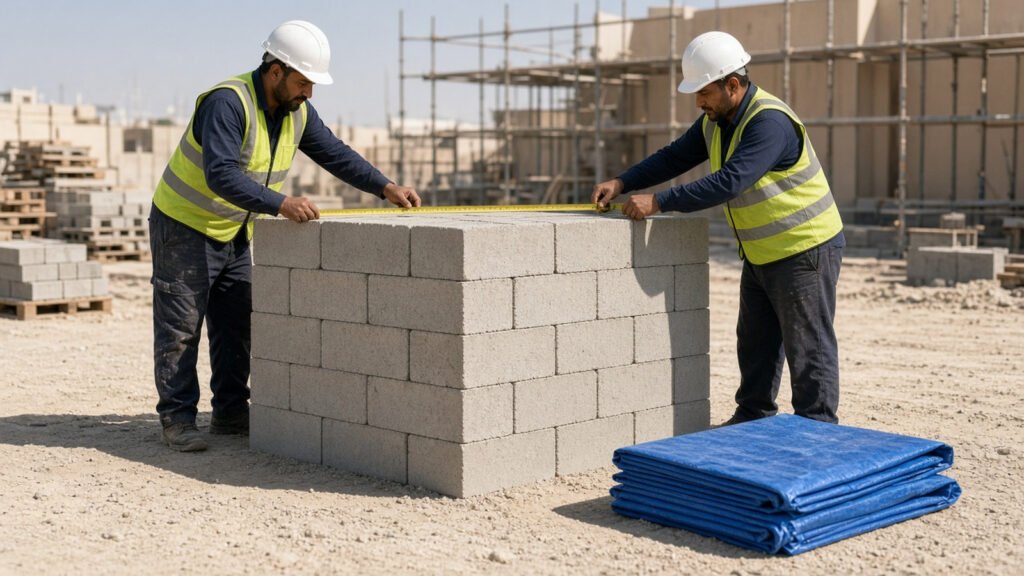
Measure the longest length (L), widest width (W) and highest point (H), even if the stack is uneven. Required length is L + (2 × H) + overlap, and required width is W + (2 × H) + overlap. Use about 2 ft (0.6 m) of overlap so you can tie the sheet down.
Worked example (feet): a pallet 6 ft long, 4 ft wide and 4 ft high needs 6 + 8 + 2 = 16 ft by 4 + 8 + 2 = 14 ft. An 18 × 18 ft sheet covers it with a margin. The same stack in metres is about 1.8 × 1.2 × 1.2 m, needing roughly 4.9 × 4.3 m; 5.5 × 5.5 m (18 × 18 ft) still fits.
A material stack 20 × 15 × 6 ft needs about 34 × 29 ft, so a 40 × 40 ft sheet is the usual step up. A bulk stack 44 × 40 × 6 ft needs about 58 × 54 ft, which is why a 60 × 60 ft sheet is the practical standard size. Photograph the load with a tape in the frame if you are sending dimensions to a supplier.
Which standard tarpaulin sizes fit common UAE jobs?
Standard tarpaulin sizes save time if your calculated cover is close to a stock sheet. The chart below shows common sizes in feet and metres, including the three PVC sizes we list. Area figures are calculated from the nominal size, not from a finished, hemmed measurement.
| Size (ft) | Size (m, approx.) | Area (m², approx.) | Typical use |
|---|---|---|---|
| 18 × 18 | 5.5 × 5.5 | 30 | Pallets, small stacks, pickup loads, tool stores |
| 40 × 40 | 12.2 × 12.2 | 149 | Building materials, generators, truck loads, mid-size yard stacks |
| 60 × 60 | 18.3 × 18.3 | 334 | Large yards, bulk stock, wide machinery cover |
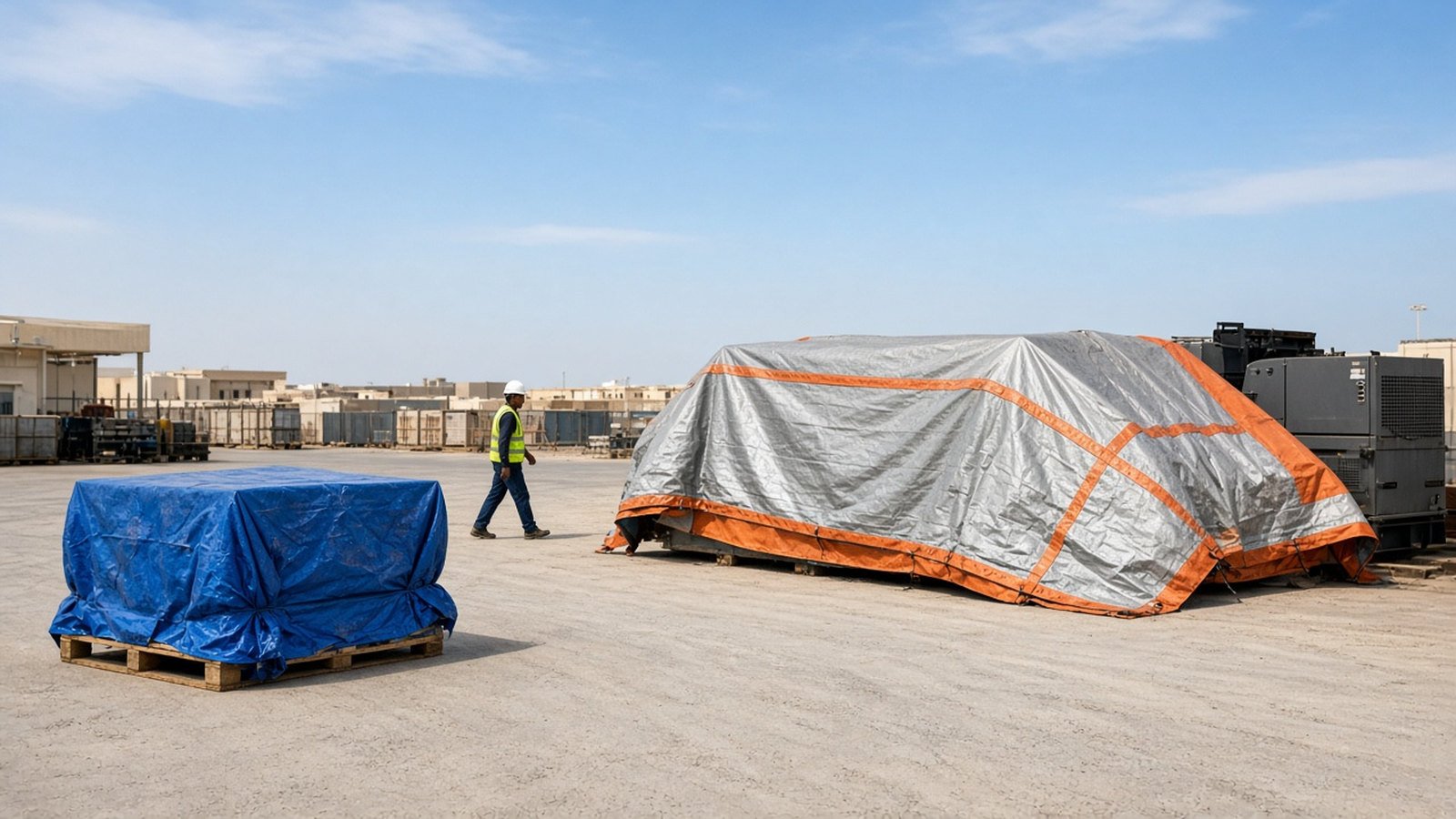
We list the 18 × 18, 40 × 40 and 60 × 60 ft PVC sheets on the product page. If your calculation falls between two sizes, take the larger one, or ask about a custom rectangle. Do not scale a smaller sheet by stretching it.
How does a GSM chart sit alongside tarpaulin sizes?
Tarpaulin sizes tell you whether the sheet will cover the load. GSM tells you how heavy-duty that sheet is. GSM means grams per square metre. A higher GSM usually means a thicker, tougher fabric, and also a heavier sheet to handle. It is not a guarantee on its own — coating and UV treatment still matter.
| GSM (typical range) | Best for | Outdoor life in UAE sun |
|---|---|---|
| 100–150 | Short-term or indoor cover, light dust protection | Short — often only weeks if left out |
| 150–250 | General construction and storage cover | Medium — inspect regularly |
| 250 and above | Longer site cover, windy yards, repeated reuse | Longer, if tied and stored properly |
These bands are common industry ranges, not a promise for every product. Always read the actual specification. Our listed 40 × 40 ft PVC sheet is rated at 200–250 GSM. The 18 × 18 ft sheet is described as lightweight, and the 60 × 60 ft sheet as heavy-duty; ask us for the GSM on the batch you are buying if you need it in the quote.
A quick rule: a few days outdoors can use a lighter sheet; weeks usually want a mid-range GSM; months or reuse across jobs want a heavier specification. A heavier sheet that lasts longer is often cheaper per month than a light one you replace twice. Care and storage also change the outcome — see our tarpaulin maintenance tips for UAE weather.
How should you overlap, join and fix the sheet?
Use all the eyelets, not only the corners. Pull the sheet snug, but do not drum-tight it; a little slack is safer in strong wind than a strained hem. Slope the cover so water runs off. If you must join two sheets, overlap them by at least 30–60 cm, with the upwind sheet on top, and fix along the joint.
Pad sharp corners so they do not cut the fabric. Recheck ties after a storm. Fold the sheet only when it is dry, and store it in the shade. A normal PVC sheet is not spark protection; keep it away from hot work, and use a proper welding or fire blanket instead. For how people actually use covers on site, see tarpaulin covering work in the UAE. For buying and delivery checks, see how to choose a tarpaulin supplier in Abu Dhabi.
FAQs about tarpaulin sizes
What size tarpaulin do I need?
Measure length, width and height of the load, then add twice the height and about 2 ft (0.6 m) of overlap on each plan dimension. Round up to the next standard size. A 6 × 4 × 4 ft pallet usually fits an 18 × 18 ft (about 5.5 × 5.5 m) sheet.
What are standard tarpaulin sizes in metres?
Common stock sizes we list convert to about 5.5 × 5.5 m (18 × 18 ft), 12.2 × 12.2 m (40 × 40 ft) and 18.3 × 18.3 m (60 × 60 ft). Other markets also quote rectangular sizes. Confirm whether the quotation is in feet or metres, and whether it is cut size or finished size.
Is there a tarpaulin sheet size chart I can use?
Yes — the size chart in this guide lists those three standard sizes in feet and metres, with approximate area and typical uses. If your calculated cover falls between two sizes, take the larger sheet or ask for a custom rectangle rather than stretching a smaller one.
What does a tarpaulin GSM chart tell me?
The GSM chart sits next to the size chart. Size is about coverage; GSM is about how heavy-duty the fabric is. Mid-range GSM (around 150–250) is typical for general construction cover; heavier fabric is usual when a sheet will sit in the sun for months or be reused.
Should I order in feet or metres?
Either is fine if both sides use the same unit. Many UAE quotations still use feet. Write the unit on the purchase order, and convert with 1 ft = 0.3048 m if your drawings are metric. Do not mix units in the same order.
When is a custom size better than a standard sheet?
When the load is an unusual rectangle, when a standard sheet would leave a large, wind-catching surplus, or when one stock size is slightly too short. Share finished dimensions and eyelet needs with the supplier and compare the lead time against the next standard size.
If you already have the measurements, request a quote from Cactus GGT with the required length, width, GSM and delivery location and we can check a stock or custom sheet.