Fire safety on industrial sites in the UAE is not a matter of preference. It is a legal obligation governed by the UAE Fire and Life Safety Code of Practice, enforced by the Abu Dhabi Civil Defence (ADCD) and the Dubai Civil Defence (DCD). Every site manager, HSE officer, and procurement team working in construction, oil and gas, manufacturing, or warehousing in the UAE must understand what fire safety equipment their site requires and when each type of equipment is the right tool for the job.
One question that comes up regularly among safety professionals across Abu Dhabi and Dubai is this: when does a site need a fire blanket roll, when does it need a fire extinguisher, and when does it need both? The answer is not as straightforward as it might seem, and getting it wrong can mean non-compliance penalties, failed inspections, or far worse — an uncontrolled fire incident that a proper safety setup could have contained.
This guide breaks down the difference between fire blanket rolls and fire extinguishers, explains what UAE Civil Defence guidelines say about each, and helps you understand how to equip your site correctly.
Understanding the UAE Fire and Life Safety Code of Practice
Before getting into the comparison, it is important to understand the regulatory framework that governs fire safety across the UAE. The UAE Fire and Life Safety Code of Practice is the primary document that sets out requirements for fire detection, suppression, and prevention across all building types and industrial categories. It is developed under the Ministry of Interior’s Civil Defence General Headquarters and applies across all seven emirates, with Abu Dhabi and Dubai maintaining their own aligned civil defence frameworks.
The Abu Dhabi Civil Defence (ADCD) is the primary authority for fire safety compliance in Abu Dhabi. According to ADCD guidance, businesses and facility managers must obtain approvals, conduct regular inspections, and ensure that all fire safety products used on their premises meet certified standards. Non-compliance can result in fines of up to AED 50,000 and potential suspension of operations.
For industrial sites specifically, the UAE code requires a layered approach to fire protection. This means no single product covers all scenarios. Fire extinguishers, fire blanket rolls, sprinkler systems, fire alarm systems, and emergency lighting all serve distinct purposes, and each must be present in the right quantities and locations based on the site’s hazard classification and size.
You can review official Civil Defence standards and requirements through the Abu Dhabi Civil Defence Authority portal to understand the specific compliance criteria for your facility type.
What Is a Fire Blanket Roll and How Is It Used on Industrial Sites?
A fire blanket roll is a continuous roll of high-temperature resistant fiberglass fabric designed to smother flames, contain sparks, and provide thermal protection in industrial environments. Unlike the smaller domestic fire blankets used in kitchens, industrial fire blanket rolls are supplied in large dimensions — typically 1 meter wide and 50 meters long — and can be cut to the required size for any specific application.
On industrial sites, fire blanket rolls serve several distinct purposes. In welding and hot-work zones, sections of fire blanket are placed around the work area to contain sparks and prevent them from igniting surrounding materials. In areas where cables, pipes, or structural elements pass through fire-rated walls, fire blanket material is used as a passive fire containment measure. In storage and process areas, fire blanket rolls are used to wrap equipment or cover flammable materials during nearby hot work operations.
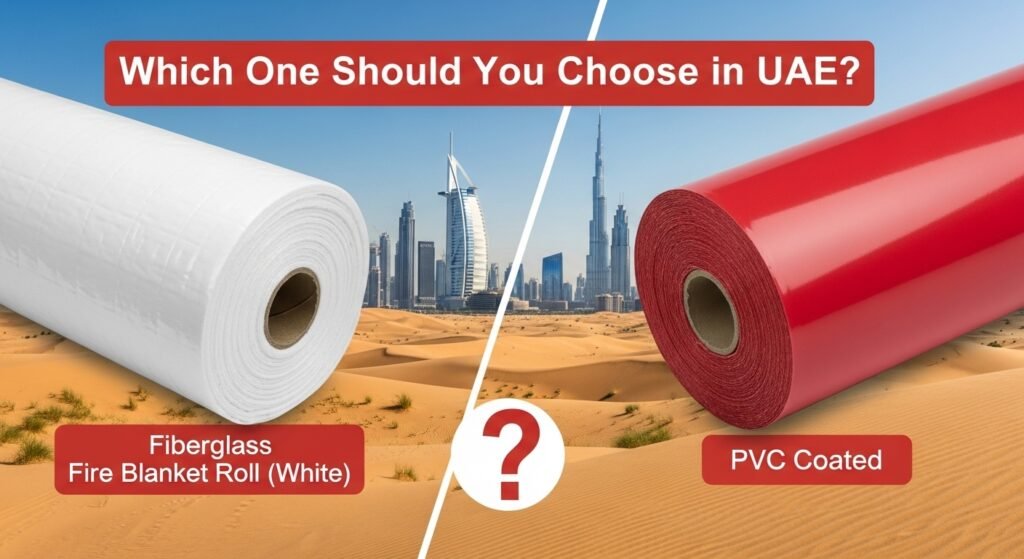
The two main types of industrial fire blanket rolls available in the UAE are PVC coated fiberglass fire blanket rolls and plain fiberglass fire blanket rolls (white). PVC coated variants offer enhanced resistance to moisture, oil, and chemical splashes, making them particularly suited for oil and gas environments. Plain fiberglass rolls provide superior heat resistance and are lighter in weight, making them the preferred choice for general welding and fabrication work.
Cactus Global General Trading supplies both variants from Abu Dhabi, with rolls available in 1m x 50m dimensions for bulk industrial supply. You can see full product specifications on our fire blanket roll page.
What Is a Fire Extinguisher and When Is It Required?
A fire extinguisher is an active fire suppression device that discharges an extinguishing agent — dry chemical powder, CO2, foam, or wet chemical directly onto a fire to suppress it. Unlike a fire blanket which smothers and contains, a fire extinguisher actively attacks the fire using a chemical agent suited to the fire class.
The UAE Fire and Life Safety Code classifies fires into classes A through F, with each class requiring a specific type of extinguisher. Class A fires involve ordinary combustibles like wood and paper. Class B involves flammable liquids. Class C involves flammable gases. Class E covers electrical fires. Understanding the fire classes present in your facility is the first step to selecting the right extinguisher type.
On industrial sites, fire extinguishers are mandatory at every designated exit point, in server rooms and electrical cabinets, near fuel and chemical storage, in vehicle workshops, and in all enclosed working spaces above a defined floor area threshold. The UAE Civil Defence code specifies minimum quantities and placement intervals based on the floor area and occupancy type of the facility.
Fire Blanket Roll vs Fire Extinguisher: Key Differences Explained
Understanding the core differences between these two products helps site managers make the right procurement and placement decisions.
How They Extinguish Fire
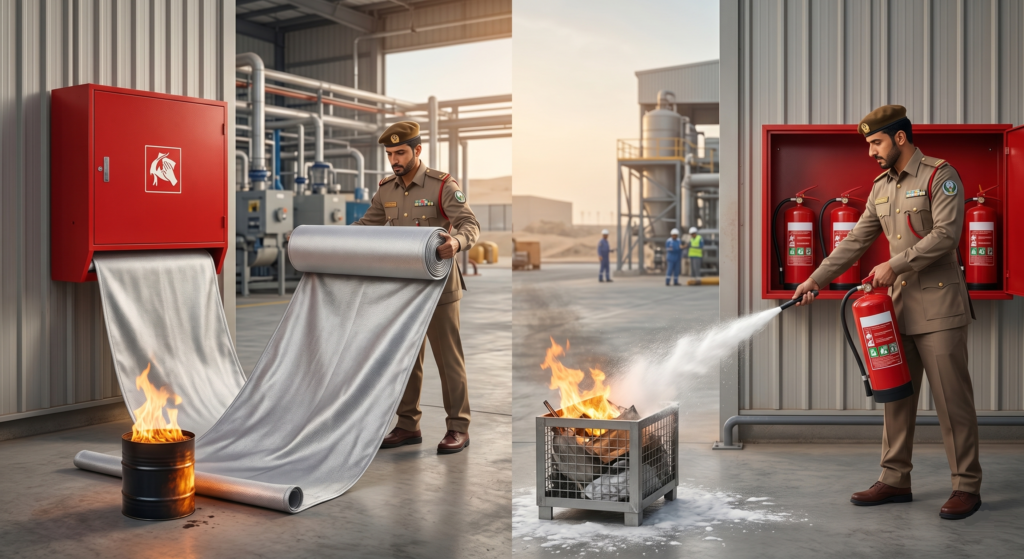
A fire blanket works by cutting off the oxygen supply to the fire. When placed over flames, the dense fiberglass fabric creates an airtight seal that starves the fire of the oxygen it needs to continue burning. This makes fire blankets highly effective for contained fires on surfaces, equipment covers, and in welding areas where the fire source is localized.
A fire extinguisher works by applying an extinguishing agent that either cools the fire, displaces oxygen, interrupts the chemical chain reaction of combustion, or a combination of these mechanisms depending on the agent type. Extinguishers are designed for active attack on fires that have already spread beyond a single surface.
Suitable Fire Classes
Fire blankets are most effective on Class A fires involving solid combustibles and Class F fires involving cooking oils or fats. In industrial contexts, they excel at containing welding sparks before they ignite surrounding materials, covering small equipment fires, and providing thermal protection for workers in hot-work zones.
Fire extinguishers are far more versatile across fire classes. Depending on the agent, a single extinguisher can cover Class A, B, C, or E fires. For industrial sites with multiple fire hazard types, the right extinguisher specification is essential.
Reuse After Deployment
One of the practical differences relevant to industrial procurement is that fire blanket rolls, particularly welding protection blankets, are designed for repeated use in industrial protection tasks. A fiberglass welding fire blanket used to cover equipment during a hot-work operation can be repositioned and reused across multiple jobs, provided it has not been damaged by extreme heat or molten material.
Fire extinguishers, once discharged, must be recharged or replaced before they are compliant for use again. This creates an ongoing servicing cost that site managers must account for in their fire safety budgets.
Speed of Deployment
In an emergency on a welding site or a hot-work area, a fire blanket can be deployed in seconds. The user simply pulls the blanket from its roll or storage bag and places it over the fire or the at-risk area. There is no mechanism to operate, no agent to direct, and no risk of agent misapplication.
A fire extinguisher requires the user to pull the safety pin, aim the nozzle at the base of the fire, and squeeze the handle. While this is straightforward, it requires a slightly higher level of familiarity and the correct agent for the fire class. Incorrect agent use on the wrong fire class can make a situation more dangerous, not less.
What UAE Civil Defence Recommends for Industrial Sites
The UAE Civil Defence framework takes a combined approach to fire safety on industrial sites. Neither fire blankets nor fire extinguishers alone are considered sufficient. The code requires facilities to maintain multiple layers of protection that work together.
For industrial sites in the UAE, Civil Defence requirements make fire extinguishers mandatory across all categories of industrial buildings. The type, quantity, and placement of extinguishers must align with the hazard classification of the facility, the floor area, and the activities being carried out.
Fire blankets are specifically called out in the UAE Civil Defence product standards as an approved fire safety product that must meet certified testing standards. The UAE Civil Defence General Headquarters maintains a list of registered laboratories and approved products, within which fire blankets are explicitly listed as products subject to certification requirements. This means that not all fire blankets on the market are Civil Defence approved. Products must meet international standards including BS EN 1869 and relevant fiberglass fabric specifications.
For welding and fabrication operations specifically, the use of fire blankets is considered best practice and in many cases a formal site requirement under hot-work permit systems. Any facility that conducts welding, cutting, or grinding operations is expected to have fire blankets in place around the hot-work area as part of the permit-to-work safety controls.
For oil and gas facilities operating under ADNOC’s HSE framework, fire blankets are part of the mandatory fire safety equipment inventory on active sites, particularly in areas classified as hazardous zones.
When Your Site Needs a Fire Blanket Roll Specifically
Certain site conditions and activity types make fire blanket rolls the specifically appropriate tool rather than simply an additional nice-to-have item.
If your site conducts welding, grinding, or cutting operations, fire blanket sections placed around the work area are a standard HSE requirement under hot-work permits in the UAE. The fire blanket prevents sparks and molten metal from traveling to surrounding materials, which is a leading cause of secondary fires on industrial sites.
If your site handles electrical cable work or cable trays in active areas, fire blanket material is used to wrap cables and protect them from heat damage during nearby hot work. This is a common requirement in oil and gas plant maintenance and in high-voltage electrical installations.
If your site has workers operating in enclosed or confined spaces with heat sources, wrapping the surrounding area with fire blanket material provides passive thermal protection that an extinguisher cannot offer proactively.
If your site stores materials that are heat-sensitive near process areas, fire blanket sections act as thermal barriers during operations that generate sparks or elevated heat.
Our fire blanket roll products are supplied in 50-meter rolls, giving sites the flexibility to cut the exact amount needed for each application, whether that is a 2-meter covering for a small welding task or a full enclosure system for a large fabrication zone.
When a Fire Extinguisher Takes Priority
Fire extinguishers are the first-response tool when a fire has already ignited and needs to be actively suppressed. They are irreplaceable in situations where a fire has moved beyond a single contained surface and is spreading or growing.
On industrial sites, fire extinguishers take clear priority in electrical panel rooms and switchgear areas, vehicle bays and heavy equipment maintenance zones, chemical and fuel storage areas, site offices and canteen facilities, and any enclosed building where people are present and a fire evacuation may be required.
The key principle from the UAE Civil Defence framework is that extinguishers address fires that have started, while fire blankets and other passive measures prevent fires from starting or spreading in the first place. Both functions are necessary on a compliant industrial site.
Practical Compliance Checklist for Industrial Site Managers in UAE
Meeting UAE Civil Defence requirements for a fully compliant industrial site involves addressing both active and passive fire protection. Here is a practical reference point for site managers conducting their fire safety review.
All fire extinguishers must be of the correct type for the fire classes present on site, placed at approved intervals and heights, tagged with the last inspection date, and serviced annually by a Civil Defence approved contractor.
Fire blanket rolls must be from certified manufacturers meeting BS EN 1869 or equivalent standards, stored in accessible locations near hot-work zones, replaced or inspected if damaged, and documented in the site’s fire safety inventory.
Hot-work permits must specify the fire blanket coverage area for every welding or cutting operation.
All fire safety products on site must be sourced from suppliers whose products are certified by UAE Civil Defence approved laboratories. As noted on the UAE Ministry of Interior Civil Defence approved products list, fire blankets are among the products that must meet registered laboratory certification.
For Abu Dhabi sites, compliance documentation should be submitted through the ADCD e-services portal and any inspections must be facilitated as requested.
The Cost Argument: Why Fire Blanket Rolls Are a Smart Investment for UAE Sites
Beyond compliance, there is a strong economic case for including fire blanket rolls as a core part of your site’s fire safety inventory. A quality fiberglass fire blanket roll can be used repeatedly over the life of a project, providing ongoing protection at a significantly lower cost per use than single-use fire safety alternatives.
As highlighted in our earlier blog on the must-read fire blanket guide for industrial sites, fire blankets require no recharge fees, no hazardous agent cleanup after deployment, and minimal maintenance between uses. For sites with active welding and hot-work programs, the cost savings over a 12-month project period are meaningful.
Fire extinguishers, while essential, carry recurring servicing and recharge costs that must be budgeted for. A combined approach that uses fire blankets for prevention and containment in hot-work zones, while keeping extinguishers as the active suppression response tool, gives the most cost-effective and compliant fire safety setup for UAE industrial sites.
Common Mistakes UAE Industrial Sites Make With Fire Safety Equipment
Several recurring issues come up during Civil Defence inspections of industrial sites in Abu Dhabi and Dubai that are worth highlighting here.
Using uncertified fire blankets is one of the most common. Not all fire blankets sold in the UAE meet the certification standards required by Civil Defence. Purchasing from a verified, quality-assured supplier matters far more than getting the cheapest available option.
Relying on fire extinguishers alone in welding areas is another frequent finding. Hot-work zones require passive fire containment measures — specifically fire blankets around the work area. An extinguisher in the corner of a welding workshop does not satisfy the hot-work permit requirements that specify blanket coverage around the weld point.
Failing to document fire safety equipment in site safety plans is a third common issue. Civil Defence inspectors check not just whether equipment is present but whether it is accounted for in the facility’s approved fire safety documentation.
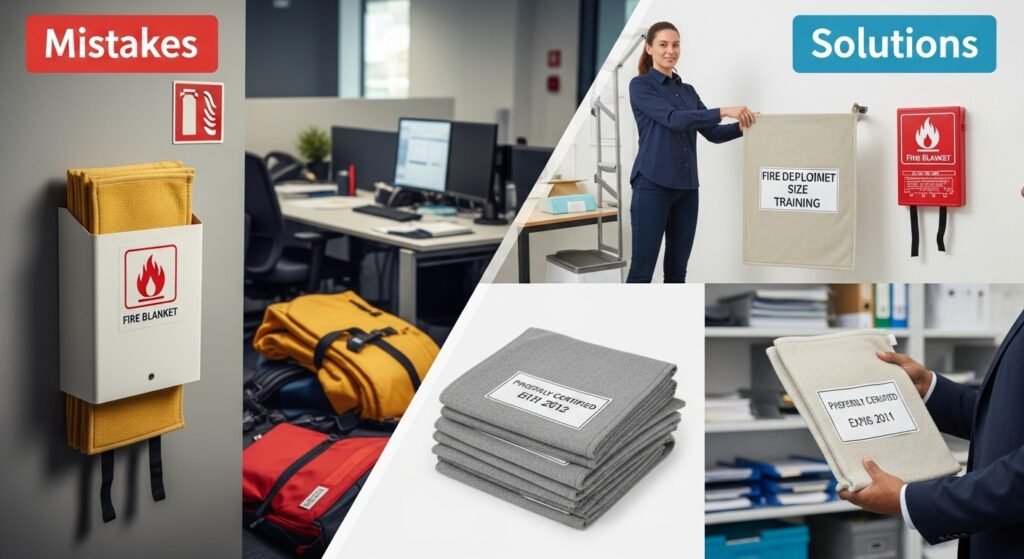
Our earlier blog on top mistakes UAE businesses make when choosing fire blankets covers this topic in useful detail for safety officers preparing for Civil Defence inspections.
Where to Source Civil Defence Compliant Fire Blanket Rolls in Abu Dhabi
Cactus Global General Trading LLC is a trusted supplier of fiberglass fire blanket rolls in the UAE, supplying industrial sites, construction projects, oil and gas facilities, and commercial buildings across Abu Dhabi, Dubai, Sharjah, and the wider UAE. Our products are manufactured from premium woven fiberglass fabric and are available in both PVC coated and plain white variants.
We supply fire blanket rolls in standard 1m x 50m dimensions, suitable for bulk industrial procurement and site-wide deployment. Both product variants can be viewed and requested through our fire blanket roll page.
Our team understands the specific documentation requirements that procurement officers and HSE managers need for Civil Defence compliance submissions, and we are happy to provide product technical data sheets to support your site’s safety documentation.
To get a fast quote for fire blanket rolls or to discuss your site’s specific requirements, visit our get a quote page or call us directly at +971 56 422 0307. We are based in Musaffah M14, Abu Dhabi, and deliver across the UAE.
Fire Blanket Roll or Fire Extinguisher?
The honest answer is that your industrial site needs both, and UAE Civil Defence regulations are built around exactly that expectation. Fire blanket rolls and fire extinguishers serve complementary roles in an industrial fire safety system, and neither can fully substitute for the other.
Fire blanket rolls are your primary tool for preventing fires from starting in hot-work zones, containing sparks, providing thermal protection, and passively shielding equipment and personnel during welding and fabrication operations.
Fire extinguishers are your active response tool when a fire has ignited, providing the chemical suppression needed to bring a growing fire under control before it spreads beyond containment.
Both must be sourced from certified suppliers, maintained to Civil Defence standards, and documented in your site safety plan. Getting this right protects your workers, your assets, your project timeline, and your organization’s compliance standing.
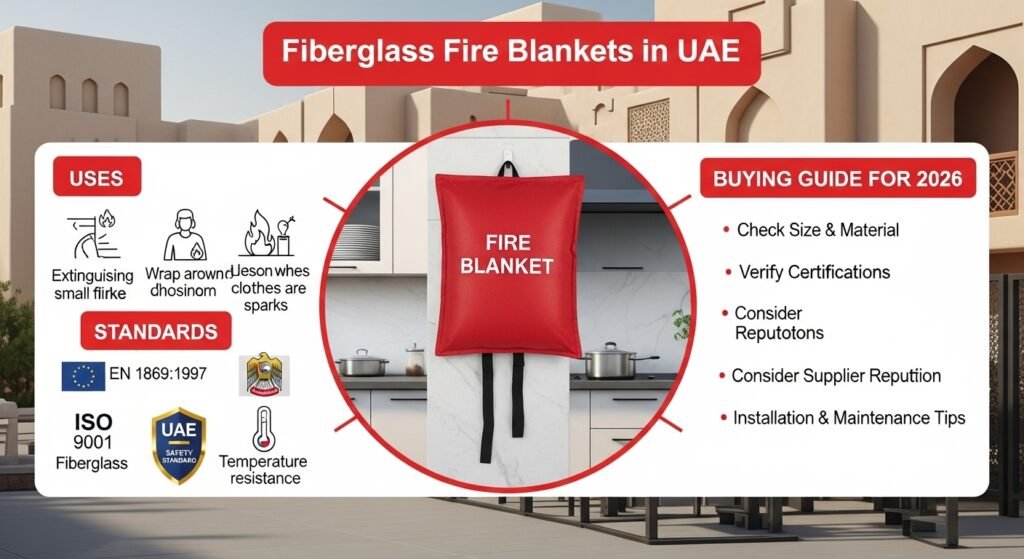
If you need fire blanket rolls for your site or want to understand more about what your specific facility requires, reach out to the Cactus Global General Trading team today. You can also explore our related blog on fiberglass fire blankets in UAE: uses, standards, and buying guide for more detailed product guidance.